
Furnace Not Turning On Tripped Breaker or Switch? Do This
Key Takeaways
- Check your CO alarms before you reset anything. CO cannot be seen or smelled.
- Reset a tripped furnace breaker one time only. A second trip means a real fault.
- Find and use the furnace switch and the panel breaker as a pair. Either can cut power.
- A breaker trips from an overload, a short, a ground fault, or a failing blower motor.
- Call an electrician for a breaker that trips again, a hot or buzzing panel, or a burnt smell.
- Call an HVAC tech for ignition, flame sensor, limit switch, inducer, gas, or control board problems.
- Wiring changes in Minnesota need an electrical permit pulled by a licensed contractor. A plain reset does not.
- Call 763-200-5956 or book online. We are America’s On-Time Electrician(R).
Furnace Not Turning On? Start With Safety
If your furnace is dead and you found a tripped breaker or an “off” switch, you can usually reset it once. Check for carbon monoxide (CO) first. Then flip the switch or breaker one time. If it trips again, stop and call.
That one rule covers most winter no-heat calls we see across the Twin Cities.
We are Northern Mister Sparky, a locally owned and operated electrician. We handle the electrical side of a no-heat problem. Furnace parts like the igniter, flame sensor, and inducer belong to an HVAC tech. We will tell you which is which, so you do not wait in the cold for the wrong truck.
Many online furnace guides send you straight to an HVAC company. Others tell you to reset the breaker and stop there. Few explain why a breaker trips or how to shut power off safely. Almost none say whether the fault is electrical or mechanical.
Should You Check for Carbon Monoxide Before You Reset Anything?
Yes. Check your CO alarms first. You cannot see or smell CO, and a furnace problem is one way it can build up. If an alarm is sounding, get everyone outside and call 911 before you touch the furnace.
The U.S. Consumer Product Safety Commission notes that CO “can’t be seen or smelled”. It also says symptoms can look like the flu. Headaches, nausea, and tiredness are easy to blame on a winter bug.
Treat these as a warning:
- Everyone in the house feels sick at the same time.
- Symptoms ease when you leave home and return when you come back.
- A CO alarm is chirping, sounding, or showing a reading.
Do not keep trying to restart a furnace while anyone feels ill. Get out first. Get checked. Call the fire department or your gas utility.
What does Minnesota law say about CO alarms?
Minnesota law is clear. Every single-family dwelling “must have an approved and operational carbon monoxide alarm”. The alarm must be installed “within ten feet of each room lawfully used for sleeping purposes.”
The same law defines what “installed” means. Under the state’s definition, an approved alarm is hardwired, plugged directly into an outlet without a switch, or attached to the wall if battery-powered.
A no-heat night is a good time to test your alarms. Press the test button on each one. Replace dead batteries now. If you have no alarm near the bedrooms, we install hardwired units. Our carbon monoxide detector service covers placement and wiring. Our guide to hardwired CO detector installation in Minnesota explains the options.
How Do You Shut Off Furnace Power Safely?
Turn off the furnace switch first, then the breaker. Do not open the furnace cabinet or touch wiring. Powering down is the only electrical step a homeowner should take. Anything beyond that, such as testing wires, is a job for a licensed pro.
Many no-heat guides skip this part. They tell you to flip things on and off without saying how to do it safely. Use this order.
- Set the thermostat to “off.” This stops a call for heat while you work.
- Find the furnace switch. It often looks like a regular light switch. It sits on or near the furnace, or at the top of the basement stairs.
- Flip the switch off. Wait about a minute.
- Find the furnace breaker in your panel. Stand to the side of the panel and use one hand if you can. Keep your face away from the panel door.
- Check that your hands and floor are dry. Never touch the panel while standing in water.
If you smell burning, see scorch marks, or hear sizzling, do not open the panel. Leave it alone and call us. Our emergency electrician service is there for this exact case.
Why does power-off matter before a reset?
A furnace has a motor, a transformer, and a control board. Each one can fail in a way that draws too much power. Cycling a breaker on and off over and over can heat the breaker and wiring. Turning power off between tries gives the system a clean start. It also keeps you away from live parts.
Where Is the Furnace Switch and Breaker?
You are looking for two things. One is the furnace switch near the unit. The other is the breaker in your main panel. Both feed the same furnace. If either one is off or tripped, the furnace stays dead.
The furnace switch
Look for a switch plate on a wall or joist near the furnace. It often has a cover. It may look like a light switch. Some homeowners flip it by mistake while doing laundry or storing boxes. That happens more than you might think in a basement full of holiday bins.
We wrote a full guide on this, furnace wiring and the disconnect switch. It shows what the switch does and what code expects.
The panel breaker
Open your panel door. Look for a breaker labeled “Furnace,” “Heat,” or “Boiler.” A tripped breaker sits in the middle position, between “on” and “off.” Some panels show an orange or red flag.
A mislabeled panel makes this harder. If the labels are faded or missing, you may be guessing. Our guide on labeling your breaker panel walks through the process. If you want it done for you, ask us about panel mapping.
To reset a tripped breaker, push it firmly to “off” first. Then push it back to “on.” Skipping the full “off” position is the most common reason a reset seems to fail.
Why Does My Furnace Trip the Circuit Breaker?
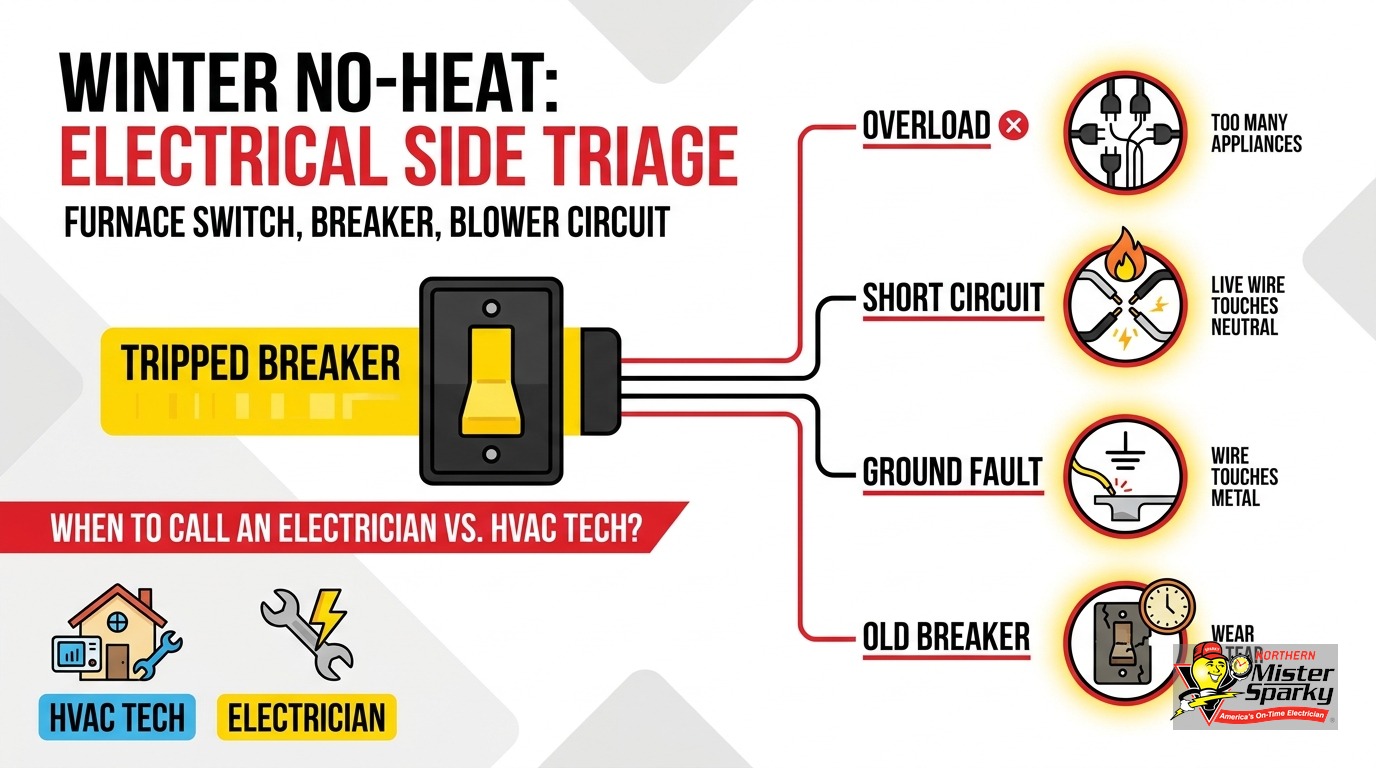
A furnace breaker trips for one of four reasons: an overload, a short circuit, a ground fault, or a failing blower motor. Each one means more current flows than the circuit can safely carry. The breaker opens to protect the wiring and your home.
Here is what each one means in plain terms.
Overload
An overload means the circuit carries more than it was built for. A furnace circuit is usually dedicated. It should serve the furnace and little else. In older homes, though, we sometimes find a furnace sharing a circuit with a basement outlet, a sump pump, or a freezer. When one more load kicks on, the breaker trips.
Cold weather adds strain. A furnace that runs longer in a deep freeze pulls power longer. A circuit that was “fine” in October can start tripping in January.
Short circuit
A short happens when a hot wire touches a neutral wire or another hot wire. Current surges. The breaker trips fast, often with a loud snap. Causes include chewed wire insulation, a loose connection, or a damaged control cable.
Mice like warm furnace areas. They also like wire insulation. A short from pest damage is a real winter cause.
Ground fault
A ground fault means a hot wire touches a grounded surface, such as the furnace cabinet or a metal duct. Current takes a path it should not. This is a shock hazard, and it is one reason a breaker that keeps tripping should never be forced.
A failing blower motor
The blower motor moves warm air through your ducts. As it wears out, it can draw more current. Bearings dry out. Windings weaken. The motor works harder and trips the breaker, often a few minutes into a heating cycle.
Watch for this pattern: the furnace runs for a short time, then the breaker trips, and it repeats. That points to a motor or another part heating up under load.
For more on the general causes, read our guide on why a circuit breaker keeps tripping.
How Many Times Can You Reset a Tripped Breaker?
Once. If a breaker trips again after one reset, leave it off. A breaker that trips twice is reporting a real fault. Forcing it back on can overheat wiring, damage the furnace, or start a fire.
The one-reset rule is common advice, and it is sound. Here is the thinking behind it.
A single trip can be a fluke. A power surge, a brief overload, or a cold-start spike can trip a breaker once. A reset clears it, and everything runs fine.
A second trip is a pattern. Maybe a motor is failing. Maybe a wire is damaged. Maybe the breaker itself is worn out. In every case, more resets do not help.
Do not:
- Hold the breaker handle on with your hand.
- Tape the breaker on.
- Swap in a larger breaker to stop the tripping.
That last one is the most dangerous. A breaker is sized to protect the wire behind it. A bigger breaker lets more current flow through wire that cannot handle it. The wire heats up, and the breaker never trips. Our wire gauge and breaker size guide explains the match.
If the breaker will not reset at all, or feels loose or hot, read what is really wrong when a breaker won’t reset. Then call us.
What Else Can Cut Power to a Furnace?
If the breaker looks fine, other electrical items can still leave your furnace dead. Most are easy to check. A few are not for homeowners.
The thermostat. Dead batteries or a blank screen can stop a call for heat. Replace the batteries first. If a wired thermostat is blank, the low-voltage side may have a problem.
The blower door switch. Many furnaces have a small switch that cuts power when the blower panel is off. A panel that is not seated tightly can keep the furnace from starting. Press the panel in firmly and check that it clicks.
The transformer. A furnace has a small transformer that steps power down for the thermostat and controls. If it fails, the thermostat goes dead. Other guides show homeowners how to test thermostat voltage with a meter. We suggest leaving that to a pro. Testing live wires is not a safe habit to build.
A fuse on the control board. Some boards have a small automotive-style fuse. A blown fuse can mean a short in the low-voltage wiring. Replacing it without finding the cause just blows the next one.
A dead outlet or receptacle. Some furnaces plug in. If the outlet is dead, check its breaker and any GFCI nearby. Our guide to outlets that stop working can help.
Who Should You Call: An Electrician or an HVAC Tech?
Call an electrician when the problem is power getting to the furnace. Call an HVAC tech when the problem is inside the furnace. Most no-heat guides leave this out.
Here is a simple triage tree.
Call an electrician for:
- A breaker that trips again after one reset.
- A breaker that will not reset.
- A hot, buzzing, or humming panel.
- A burnt smell near the panel, the switch, or the furnace.
- A dead furnace switch or a dead receptacle.
- A furnace circuit that is old, undersized, or shared with other loads.
- Signs of pest damage to wiring near the furnace.
Call an HVAC tech for:
- Ignition problems.
- A flame sensor that needs cleaning or replacing.
- Limit and rollout switches that keep shutting the furnace down.
- The inducer fan.
- Gas supply or gas valve issues.
- The control board.
The gray zone is real. A failing blower motor can look electrical because it trips the breaker. But the motor is a furnace part, and the tech replaces it. We then check that the circuit and breaker are healthy, so the new motor does not trip the same breaker.
We do not do HVAC work. If you need furnace repair, our sister company Northern One Hour HVAC can help. If you also have a leak or a frozen pipe, our sister brand Northern Benjamin Franklin Plumbing handles plumbing. We stay in our lane: electrical only.
If you ever smell gas, leave the house. Call your gas utility from outside. Do not flip switches.
Does Furnace Electrical Work Need a Permit in Minnesota?
A plain breaker reset does not need a permit. Wiring changes do. A new circuit, a replaced disconnect, or other wiring work needs an electrical permit pulled by a Minnesota-licensed electrical contractor.
The Minnesota Department of Labor and Industry (DLI) sets the rules. For its virtual inspection program, you “must be a Minnesota-licensed electrical contractor.” The page says replaced and reconnected furnaces can be handled by virtual inspection. The project must already have its electrical work permit. Virtual inspections are limited to three circuits and carry a standard $35 fee.
The same page says “Any permit types not specifically mentioned above, including homeowner permits,” are excluded from that program.
Code matters too. Minnesota has adopted the 2026 National Electrical Code with an effective date of Aug. 17, 2026. Permits filed before that date must comply with the 2023 code. That means new permits now follow the 2026 code. If your furnace circuit needs a change, we build to the code in force. Our overview of Minnesota code changes for homeowners gives background on the recent update cycle. Our Minnesota electrical permit guide covers the permit process in more detail.
We pull the permits and schedule the inspection. You do not need to sort out paperwork on a cold night.
What Does an Electrician Actually Do on a No-Heat Call?
We start with safety. Then we trace the path of power from the panel to the furnace. We test, we do not guess. The usual sequence looks like this.
- Check for CO and hazards. We look for warning signs before we open anything.
- Inspect the panel. We look at the breaker, the bus connection, and the wire at the breaker. Heat marks and loose lugs tell us a lot.
- Test the circuit. We measure voltage and check for a short or a ground fault with the right tools.
- Check the furnace switch and wiring. We look at the switch, the cable, and the connections at the furnace junction box.
- Check the load. We confirm that the circuit is not shared with something it should not be.
- Repair or replace. That may mean a new breaker, a new switch, new cable, or a new dedicated circuit.
- Hand off if needed. If the fault is inside the furnace, we tell you plainly. We do not guess at HVAC parts.
That last step is no malarky. If it is not our side of the problem, we say so.
When is a new furnace circuit the answer?
Sometimes the wiring is the weak link. Signs include a circuit that trips under normal load, a furnace that shares a circuit with other devices, or cable that looks brittle or damaged. A dedicated circuit sized to the furnace’s nameplate is the usual fix.
If a panel upgrade is also on your list, we can plan both jobs at once. Financing is available for larger work, so a bigger fix does not have to wait.
How Can Twin Cities Homeowners Prevent a Winter No-Heat Call?
A little prep in the fall saves a cold night in January. None of it is complicated. Most of it takes less than an hour.
The CPSC advises that a qualified heating contractor inspect your system “annually.” It says the inspection should cover electrical and mechanical parts, thermostat controls, and automatic safety switches. That is a good yearly habit for any home with a furnace.
Add these electrical steps:
- Label your panel. Know which breaker feeds the furnace before an emergency.
- Keep the area around the furnace clear. Stored boxes can block the switch or press on wiring.
- Test CO alarms. Do it each fall, and again on any cold snap.
- Look at the furnace switch. Make sure it is on, and tell family members not to flip it.
- Watch for early warning signs. Flickering lights when the furnace starts, a warm panel door, or a breaker that trips “once in a while” all deserve a look.
Cold weather puts a load on every system in a Minnesota home. Our guide to winter electrical demand explains how heating season strains your panel. Our fall and winter safety check gives you a short checklist.
A breaker that “only trips sometimes” is easy to ignore. Don’t. An intermittent fault is still a fault. It tends to get worse, and it often picks the coldest night of the year.
When Should You Stop and Call Right Away?
Some signs mean stop now. Do not reset. Do not wait for morning. Leave the area if you feel unsafe, and call for help.
Call us right away if you see or notice:
- Burning or hot-plastic smells near the panel or furnace.
- Scorch marks, melted plastic, or discoloration on the panel, switch, or outlet.
- Buzzing, crackling, or sizzling from the panel.
- A breaker that is hot to the touch.
- A breaker that trips the moment you reset it.
- Water near the panel or the furnace.
Call 911 for fire, smoke, or a CO alarm. Call your gas utility if you smell gas.
For anything else on that list, our team is ready. Read more in our guide on burning smells from an outlet or breaker.
Why Call Northern Mister Sparky for a No-Heat Electrical Problem?
We are locally owned and operated, and we live and work in the same Twin Cities neighborhoods you do. We know how hard Minnesota winters are on a home’s electrical system. We also know a cold house cannot wait.
Here is what you can expect:
- On-time arrival. We are America’s On-Time Electrician(R). We show up when we say we will.
- A straight answer. We tell you whether it is an electrical fix or an HVAC job.
- Licensed work. We pull permits and follow current code.
- Our guarantee. Our UWIN(R) 100% satisfaction guarantee backs our work.
- Financing for larger jobs. Panel, circuit, and other bigger projects can be financed.
We serve Minneapolis, St. Paul, Bloomington, Brooklyn Park, Woodbury, Blaine, Maple Grove, Plymouth, and nearby communities.
If your furnace is dead and the breaker keeps tripping, do not keep flipping it. Call 763-200-5956 or book online. We will check your power path, fix what is ours to fix, and point you to the right HVAC help if the furnace itself is the problem.
If you want to browse more, see our repair services or our safety services.
Frequently Asked Questions
How do you reset a furnace pilot light? +
Can a homeowner pull an electrical permit for furnace wiring in Minnesota? +
Is a furnace switch the same as a breaker? +
Why does my furnace blower run but the heat never comes on? +
Need an electrician now?