
GFCI Trips When It Rains? Twin Cities Diagnosis Guide
Key Takeaways
- A GFCI that trips in wet weather is usually doing its job. It senses current leaking out of the circuit, and water is a common path.
- The wet spot is often not at the outlet you reset. It can sit at a downstream outlet, a light, or a buried line.
- Minnesota’s thaw, snowmelt, and spring storms push water into boxes, conduit, and old gaskets.
- Start with the cheap checks: covers, gaskets, and unplugging everything. Then test one device at a time.
- A GFCI that trips right away with nothing plugged in points to wiring, insulation, or a bad device.
- Never swap a GFCI for a standard outlet to stop the tripping. That removes the protection that saves lives.
- Call a licensed electrician if the trips repeat, you see corrosion, or you smell anything hot or burnt.
Why does my power keep tripping when it rains?
Rain gives electricity a path it should not have. A GFCI compares the current leaving on the hot wire with the current returning on the neutral. If a small amount goes missing, it shuts off power in a fraction of a second.
Water inside a box, a cover, or a cord connection can leak that current. The GFCI sees the leak and trips. That is the device working as designed.
The leak is rarely where you can see it. One GFCI can protect a whole chain of outlets, so a damp fixture on the far side of the garage can trip the first outlet in the chain.
The most common wet-weather causes:
- Failed or missing weatherproof covers. Cracked plastic or a stiff gasket lets rain reach the contacts.
- Water in a box. Wind-driven rain or meltwater running down a wall can pool inside.
- Damaged cords. An outdoor cord with a nick in its jacket can leak current when it lies in a wet spot.
- Wet conduit. Pipe that carries wire outside can fill with condensation, then drip into a box.
- Aging wire insulation. Old cable can break down, and moisture finds the weak spot.
- A worn GFCI. Older devices can become touchy as they age.
We see this every spring and storm season. It is one of the most common calls we get from Twin Cities homeowners.
Why does the Minnesota thaw make it worse?
Our weather is hard on outdoor wiring. Water here falls, freezes, expands, melts, and moves.
Picture a porch light box on a north wall. Ice forms in a tiny gap around the cover in January. A warm spell in March melts it. The meltwater runs into the box and sits on the wire connections.
Freezing also cracks things. Sealant dries out and plastic covers get brittle. A gasket that sealed fine in July can leak by April.
Here is how the Minnesota calendar tends to play out:
- Late winter thaw. Ice and snow against the house melt and run into boxes and conduit.
- Spring storms. Wind-driven rain gets past covers that are cracked or left open.
- Saturated ground. Wet soil can expose weak spots in buried lines to the water around them.
- Frost heave. Shifting ground can strain buried cable and pipe, and may open a seam.
- Summer humidity. Warm, damp air can leave condensation inside cold boxes and conduit.
These are general patterns we see in the field, not exact numbers. Every house is different.
If your outlet trips mostly in cold weather and not just in rain, our guide on outdoor GFCI nuisance tripping in Minnesota cold covers that side of the problem.
How do you tell a rain trip from a real wiring fault?
Watch when it trips. The timing tells you a lot.
Pattern one: it trips only during or after rain. This points to moisture reaching a box, a cover, a cord, or a buried splice. When things dry out, the circuit works again.
Pattern two: it trips the moment you reset it. Unplug everything first. If it still trips right away, the problem is likely in the wiring, the device, or soaked insulation. A new cover will not fix that.
Pattern three: it trips when one device runs. If it trips only when the pressure washer, holiday lights, or a heater is on, suspect that device or its cord.
Pattern four: it trips at random, rain or shine. That can mean a worn GFCI, a shared neutral problem, or a slow leak that has nothing to do with weather.
Write down the date, the weather, and what was plugged in. That log helps us find the fault faster.
How do you stop a GFCI from tripping outside?
Start with the simple fixes. Many wet-weather trips come from small, cheap parts. Work in order, and stay safe.
Before you touch anything, turn off the breaker for that circuit. Do not work on a wet outlet with power on. Do not stand in water.
Step 1: Unplug everything
Remove every cord from the circuit, including holiday lights, pumps, and chargers. Wait for dry weather, then reset the GFCI.
If it holds, plug devices back in one at a time. Run each for a few minutes. When the trip returns, you have found your culprit. Replace that cord or device.
Step 2: Check the cover and gasket
Look at every outdoor outlet on the circuit. Open the cover and look for:
- Cracks in the plastic
- A flattened or missing gasket
- Gaps between the cover and the wall
- Water stains, droplets, or rust inside the box
- Green or white crusty buildup on screws and contacts
Outdoor outlets that stay in use need an “in-use” cover. It keeps the cover closed over a plugged-in cord. Our post on in-use weatherproof cover requirements explains what to look for.
Step 3: Dry it out and seal it
If the box is damp, shut off the breaker and let it dry fully. If it dries in a day and trips again after the next rain, it still has a leak. Find where the water gets in. Common spots are the top of the cover, the wall seam, and the conduit entry.
Step 4: Replace worn parts
A cracked cover or brittle gasket costs little to replace. Replace a corroded receptacle too. Corrosion on the contacts means water has been there a while.
Step 5: Know where to stop
If it still trips after these steps, stop. Repeated resetting is not a fix. The leak may be inside a wall, in conduit, or underground. That job calls for a licensed electrician with the right test tools.
Should you swap the GFCI for a regular outlet?
No. Never do this.
It is tempting. The GFCI keeps tripping, a regular outlet would not, and the problem seems gone. But the leak is still there, and you have removed the device that warns you about it.
Water and electricity near people is a serious hazard. A GFCI is one of the most effective protections in a home. Outdoor and garage outlets are where it matters most.
Minnesota code also requires it. Minnesota’s Board of Electricity has adopted the 2026 National Electrical Code (NEC) with an effective date of Aug. 17, 2026. Permits filed on or after that date must follow the 2026 NEC. Permits filed before it must follow the 2023 NEC.
So if you hire someone to replace or add outdoor wiring today, the new rules likely apply to that permit. Neither edition allows bypassing the protection.
Do garages need GFCI protection too?
Yes. Most people think of “outdoor” outlets first, but garages matter just as much.
Garage floors get wet. Snow melts off cars. Hoses and pressure washers come out in spring. Concrete holds moisture and cold.
St. Paul’s garage electrical checklist says that NEC 210.8(A)(2) calls for GFCI protection of 125-volt through 250-volt garage receptacles. Bloomington’s residential inspection checklist also says all garage receptacles need GFCI protection.
The 2023 NEC also widened the outdoor outlet rule. According to the state’s code FAQ, it added garages, accessory buildings, and boathouses to the outdoor-outlet GFCI requirement.
Check with your city inspection office for how these rules apply to your home. Local interpretation can vary. We follow the current edition on every job.
For more on garage wiring rules, see our guide to attached garage electrical wiring code.
Why can a trip happen far from the wet spot?
This surprises many people. You reset the GFCI in the garage and it trips again, yet nothing in the garage looks wet.
That is often a downstream problem. A GFCI can protect other outlets “downstream” of it, wired to its LOAD terminals. A leak at any of them trips the first device.
Here is what that can look like:
- A GFCI in the garage protects an exterior outlet on the back wall.
- The exterior outlet has a cracked cover.
- Rain gets in. The GFCI in the garage trips.
- You look at the garage and see nothing wrong.
The fix is to trace the chain. We walk the circuit and check each outlet, light, and splice on it. Sometimes one GFCI protects a patio outlet, a porch light, and a garage outlet.
Some homes also have a shared neutral on a multiwire circuit. A neutral shared between two circuits can cause odd GFCI trips. Our explainer on multiwire branch circuits and shared neutrals covers how that works.
What about miswired LINE and LOAD terminals?
A GFCI has two sets of terminals. LINE is where power comes in. LOAD is where power goes out to protected outlets downstream.
If these are swapped, the device may not work right. It may refuse to reset, or trip for no clear reason. It may also fail to protect the outlets it should.
This mistake often follows a DIY swap or an older repair. It is hard to spot by eye, but an electrician can confirm it with a tester in a few minutes.
If a new GFCI will not reset, check this first. Our guide on a GFCI outlet that will not reset walks through more causes.
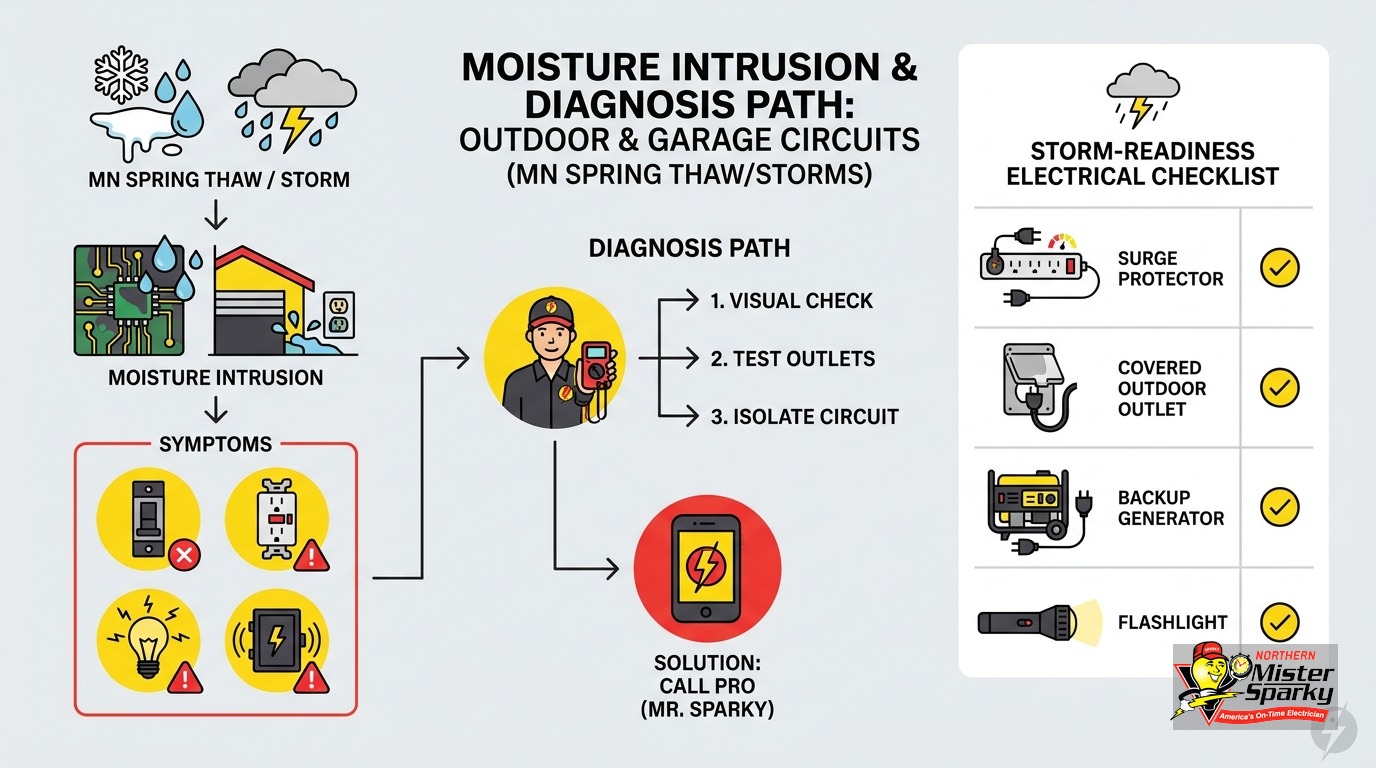
How does an electrician find the wet spot?
Guessing can take hours. The right tools cut that down.
We follow a set path:
- Interview and history. When does it trip? What changed? When was the last storm?
- Visual inspection. We check covers, gaskets, boxes, and cords at every point on the circuit.
- Isolate the load. We disconnect the downstream outlets. Then we reset the GFCI and see if it holds.
- Reconnect in sections. We bring each section back one at a time. The trip tells us where the leak is.
- Insulation testing. We use a megohmmeter, often called a megger. It sends a test voltage through the wire and reads how well the insulation holds. Low readings point to moisture or damage.
- Moisture check at each box. We open boxes and look for water, rust, and corrosion on splices.
- Device test. We test the GFCI itself and replace it if it fails.
This finds problems you cannot see from the outside. A soaked splice in a buried line, for example, will not show up in a visual check.
If the leak is in a buried line, the fix may mean replacing a section. Our post on underground electrical wire depth in Minnesota explains how those lines are run.
Can a GFCI outlet go bad but still work?
Yes. A GFCI can keep passing power after its protective circuitry has worn out. That is the dangerous version. It looks fine, but it will not trip when it should.
A worn GFCI can also go the other way and trip too easily, even in light moisture.
Test yours monthly. Press TEST. The outlet should cut power and the RESET button should pop out. Press RESET to restore power. If nothing happens when you press TEST, replace the device.
Most GFCIs last many years, but outdoor ones age faster. Heat, cold, and moisture all take a toll. If yours is old and trips often, replacement is usually cheap compared with chasing a fault that is not there.
Would a breaker that keeps tripping mean it is bad?
Not usually. A breaker that trips again and again is most often reacting to a real problem: an overload, a short, or a ground fault from moisture.
Breakers can fail, but that is less common than a circuit problem. Replacing a breaker without finding the cause can leave the real fault in place.
Two kinds of devices behave differently:
- A standard breaker trips on overload or a short.
- A GFCI breaker also trips on ground faults, like current leaking through water.
If a GFCI breaker keeps tripping when it rains, treat it like a GFCI outlet. Look for a moisture leak on the circuit it protects.
Our comparison of a GFCI breaker versus a GFCI outlet explains how the two differ. If a regular breaker keeps tripping, see our circuit breaker tripping fix guide.
Is it safe to keep resetting a GFCI that trips?
Resetting once after a storm is fine if the area is dry and you have unplugged devices. Resetting again and again is not.
Each trip is a warning that something is leaking current. If you keep forcing power back on, you may be pushing current through a wet or damaged path.
Stop and call us if you notice any of these:
- The GFCI trips more than a few times in a short stretch
- You see water inside a box that has power on
- The outlet or cover feels warm
- You smell burning or see scorch marks
- The device buzzes, sparks, or crackles
- Breakers in the panel are also tripping
If water is dripping into a live box, turn off the breaker if you can reach the panel safely. Do not touch a wet outlet. If you see smoke or fire, call 911.
What can you do before the next storm?
A little prep goes a long way. Do this each spring and fall.
- Open and inspect every outdoor outlet cover. Replace cracked ones.
- Replace flattened gaskets.
- Test each GFCI with the TEST and RESET buttons.
- Check outdoor cords for nicks and soft spots. Replace damaged ones.
- Keep cords off the ground in wet spots.
- Use outdoor-rated extension cords only, and unplug them when not in use.
- Clear snow and ice from outlets and meter areas when safe.
- Look at exterior lights and fixtures for water stains or cracks.
If you want a second set of eyes, an inspection can catch small leaks early. Our post on the February spring project prep can help you plan.
When should you call a licensed electrician?
Call when the cause is unclear or the simple fixes did not work. Also call if the work involves wiring inside a wall, in conduit, or underground.
Hire a licensed pro for:
- A GFCI that trips immediately on reset with nothing plugged in
- Repeated trips after you replaced covers and gaskets
- Corrosion or rust inside boxes
- Any sign of heat, burning, or damaged wire
- Adding or moving outlets in a garage or outdoors
- A suspected buried line fault
Permits may also come into play for larger work. We can explain what applies to your home. Our guide to the Minnesota electrical permit is a good starting point. You can also confirm a contractor’s license with our post on how to verify a licensed electrician in Minnesota.
For a tripping or failed outlet, start with our electrical outlet repair service.
We handle electrical work only. If the water is coming from a leaking pipe, our sister company Northern Benjamin Franklin Plumbing can help. If the wet problem involves your furnace or air conditioner, call Northern One Hour HVAC.
How does Northern Mister Sparky handle a wet-weather GFCI call?
We are locally owned and operated here in the Twin Cities. Our team lives in the same weather you do. We know what a March thaw does to a back porch outlet.
We are also proud to be America’s On-Time Electrician(R). When we give you an arrival window, we show up in it. Every job is backed by our UWIN(R) 100% satisfaction guarantee.
Here is what you can expect:
- A clear explanation of what we find, in plain language
- A real diagnosis, not guesswork or part swapping
- Upfront pricing before work begins
- Work done to the current Minnesota code
- Financing options on larger jobs, such as running new circuits to a detached garage
No malarky. Just a fix that holds up when the next storm rolls in.
Call us before the next storm
A GFCI that trips when it rains is telling you something. Sometimes the cause is a ten-dollar gasket. Sometimes it is a buried splice that needs real repair. Either way, find the cause instead of silencing the alarm.
Call Northern Mister Sparky at 763-200-5956 or book online. We serve Minneapolis, St. Paul, Bloomington, Brooklyn Park, Woodbury, Blaine, Maple Grove, Plymouth, and nearby communities. We will track down the wet spot and get your power back safely.
Frequently Asked Questions
Can a GFCI outlet go bad but still work? +
Would a breaker continuously tripping mean it is bad? +
Need an electrician now?