
Fish Room Electrical Requirements for Twin Cities Homes
Key Takeaways
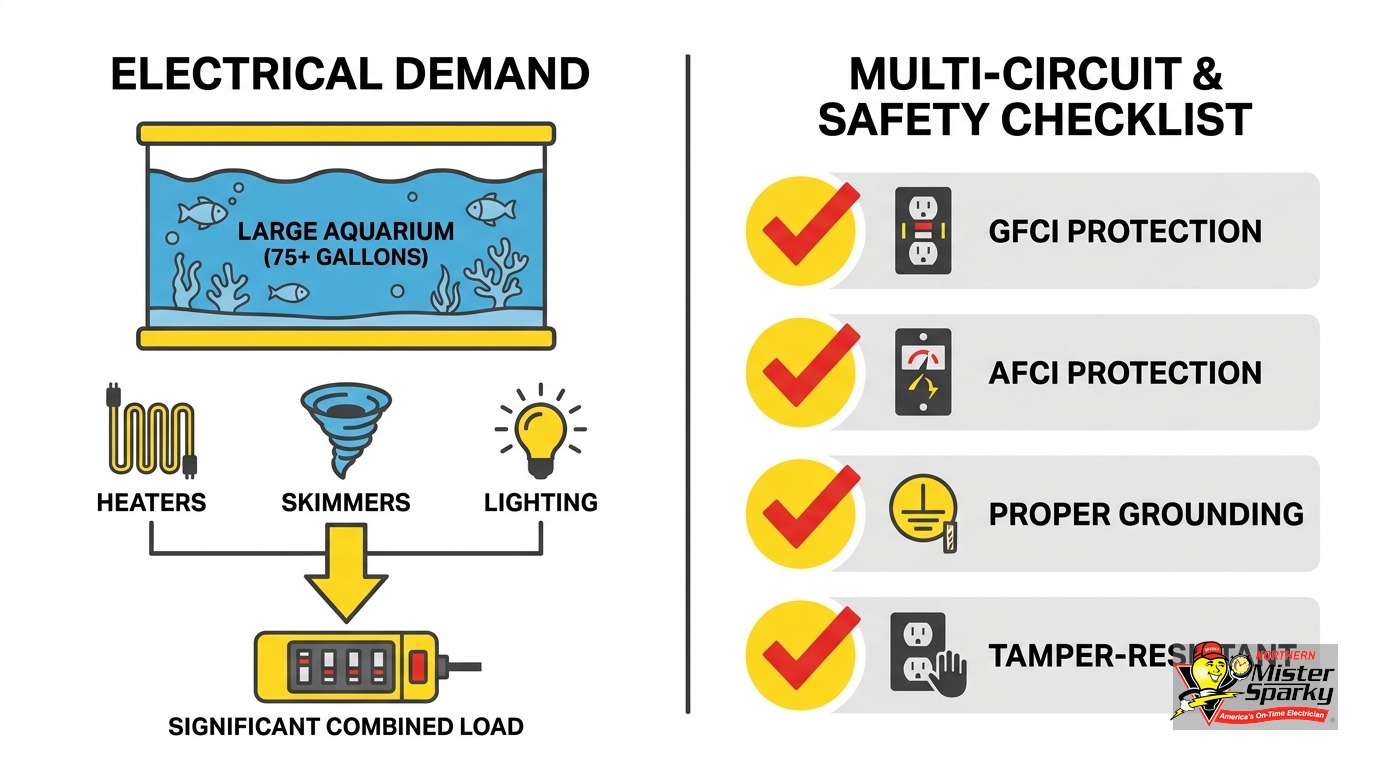
- Every receptacle in a residential fish room requires GFCI protection. Minnesota’s code applies whether the basement is finished or unfinished.
- Minnesota adopted the 2026 NEC on August 17, 2026. AFCI protection now covers every 120V 15A/20A branch circuit in the home, including fish rooms. The “skip AFCI” advice on hobbyist forums is a permit-failing code violation in Minnesota today.
- Aquarium heaters are continuous loads. The 125% sizing rule applies: a 12A heater needs at least a 15A circuit, and a 16A heater needs a 20A circuit.
- In a multi-tank room, heaters alone can nearly fill a 20A circuit. Pumps, skimmers, and lighting must run on separate circuits.
- Cold Minnesota basements change your heater math. Size circuits for worst-case winter ambient temperatures, not average room conditions.
- A fish room addition may require a subpanel or panel upgrade. Xcel Energy customers may qualify for up to $1,500 in rebates on a qualifying panel upgrade.
- Minnesota requires a separate electrical permit for new circuits or outlet locations. A licensed electrician pulls the permit and schedules both required inspections.
Why Fish Rooms Have Unique Electrical Demands
Most rooms in a home have intermittent electrical loads. Fish rooms do not. Heaters, pumps, and skimmers run continuously. Lights run on 10-12 hour timers. The circuit never recovers.
That continuous profile matters for two reasons. First, it triggers the NEC’s continuous load rule. Any load expected to run at maximum current for three or more hours must be served by a circuit sized at 125% of that load. Second, a circuit under constant load runs hotter than one that cycles on and off. An undersized circuit does not just trip occasionally. It runs at elevated temperature all the time.
Water adds another layer. Fish rooms are inherently damp. Large tanks raise the ambient humidity of an enclosed basement space noticeably. Constant current draw combined with elevated moisture is exactly what GFCI and AFCI requirements are designed to address.
Fish rooms also differ from similar utility spaces because of thermal dynamics. Unlike a laundry room, a fish room must maintain warm water against a basement ambient that can drop sharply in a Minnesota winter. That relationship affects how every circuit in the room gets sized.
Does a Fish Room Require GFCI Protection in Minnesota?
Yes. Every receptacle in a residential fish room needs GFCI protection under NEC 210.8(A). The commercial aquarium subsection cited in most hobbyist guides does not apply to homes.
Many hobbyist resources point to NEC 210.8(B)(13) as the fish room GFCI rule. That subsection covers other-than-dwelling occupancies: commercial fish stores, research labs, public aquariums. It does not apply to your home.
For a residential fish room, the code runs through 210.8(A). If the room is in an unfinished basement, every receptacle in that space requires GFCI protection. If the basement is finished, the “indoor damp and wet locations” provision under 210.8(A)(12) applies. Minnesota’s 2026 NEC GFCI requirements list unfinished basements and indoor damp or wet locations as separate, independent triggers. A fish room in a basement qualifies under at least two of them simultaneously.
If the room includes a utility sink for water changes, the within-six-feet-of-a-sink provision adds a third trigger. In practice, every outlet in a fish room should be GFCI-protected, regardless of which subsection technically applies.
For the installation itself, you have two approaches. GFCI outlets at each receptacle protect individual locations. A GFCI breaker at the panel protects the entire circuit from one point. For a room with many outlets, circuit-level protection is often more cost-effective and easier to reset after a trip.
What About AFCI Breakers? The Forum Advice Is a Code Violation
Every 120V 15A and 20A branch circuit in a Minnesota home now requires AFCI protection, including every fish room circuit. Minnesota has adopted an updated electrical code. The room exemptions that once existed for basements and utility spaces are gone. There is no opt-out.
Search any aquarium hobbyist forum for fish room wiring advice and you find consistent guidance: skip AFCI breakers because aquarium controllers nuisance-trip them. That concern was debated in earlier code cycles. In Minnesota today, it is beside the point.
The 2026 NEC removed the room-by-room exemptions that previously let some spaces avoid AFCI requirements. Every 120V 15A and 20A branch circuit in a dwelling unit now requires AFCI protection. There are no location exceptions. Pull a permit for fish room electrical work and the inspector checks for AFCI. Skip it and the inspection fails.
The practical solution is a combination AFCI/GFCI breaker installed at the panel. One breaker satisfies both requirements. Our post on combination AFCI/GFCI breakers explains when to use the combo device versus a split configuration. The alternative - an AFCI breaker at the panel plus GFCI outlets at the receptacles - also meets code and gives you granular reset control at each outlet.
On nuisance tripping: modern AFCI breakers are better calibrated than first-generation units. Most aquarium equipment runs without issue on a properly installed AFCI circuit. The cost premium is real but quantifiable. A four-circuit fish room adds roughly $100-$175 in breaker cost compared to standard breakers. That is a known line item, not a reason to skip protection the code requires.
How Do You Size Circuits for Aquarium Heaters?
Aquarium heaters are continuous loads under NEC 210.19(A)(1). Every circuit must be sized at 125% of the heater’s full draw. A 12A heater needs a 15A circuit minimum. A 16A heater needs a 20A circuit. In a cold Minnesota basement, always size for worst-case winter ambient, not average room temperature.
The math is direct. Multiply the heater’s rated amperage by 1.25. The result is the minimum circuit and breaker rating.
For wattage planning, the standard heater sizing guide recommends 3-5 watts per gallon scaled to the required temperature rise. A 75-gallon tank needing a 15°F rise needs roughly 375W. For tanks over 50 gallons, two smaller heaters rather than one large unit is standard practice. Two heaters distribute heat more evenly and provide redundancy if one fails. Both heaters draw continuous load at the same time, so size the circuit assuming both run at full draw.
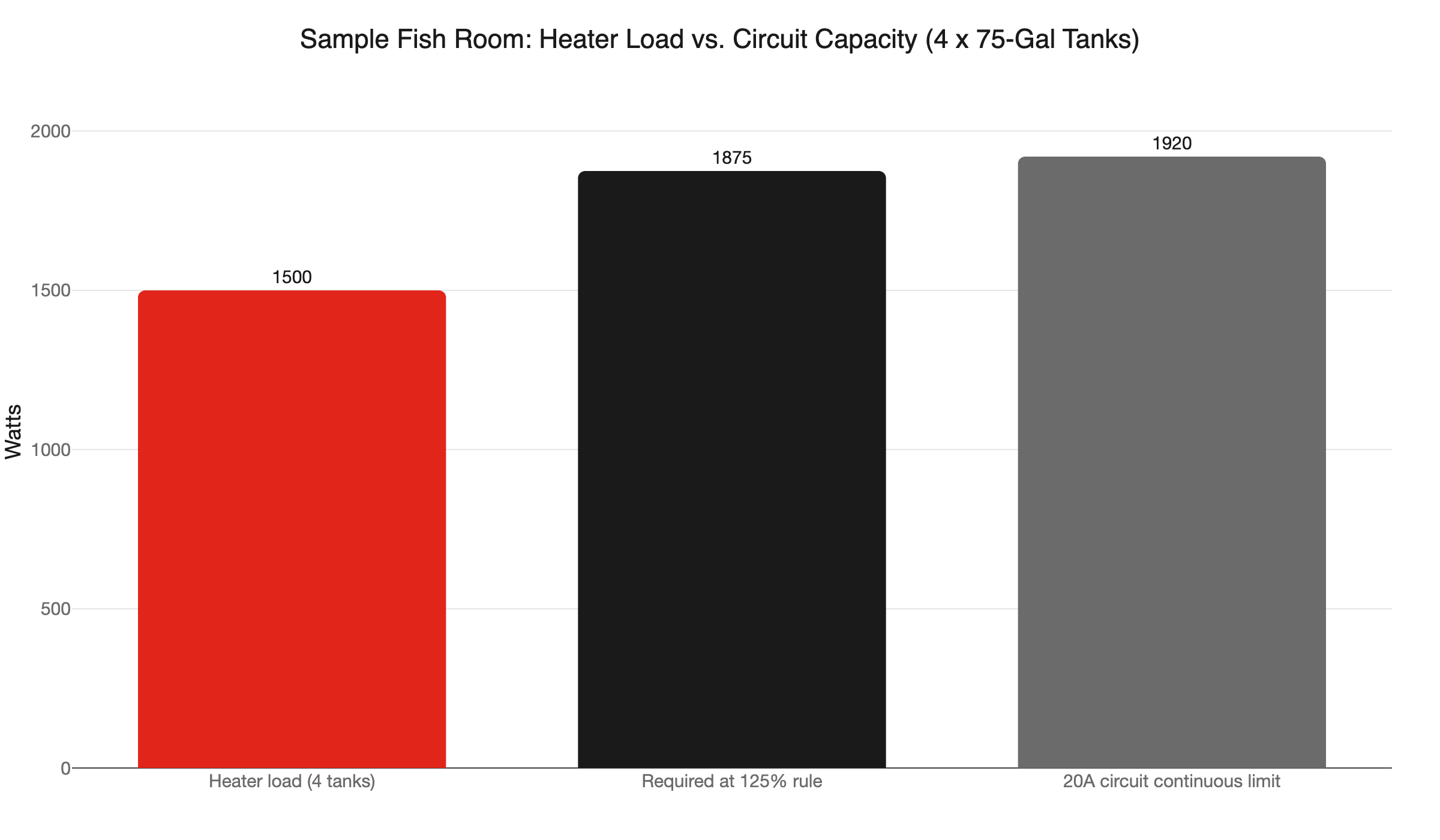
Now run the numbers across a four-tank room:
- Four 75-gallon tanks at 375W each: 1,500W of continuous heater load.
- At 125%, circuits must be sized to handle 1,875W of heater load.
- One 20A/120V circuit has a continuous limit of 1,920W.
Heaters alone nearly fill one 20A circuit. Every pump, skimmer, UV sterilizer, and light must go on a separate circuit. That is not a design preference. It is how the load math works out.
How Many Electrical Outlets Does a Fish Room Need?
Plan for at least three to four circuits in a four-tank room: one for heaters, one for pumps and filtration, one for lighting, and a utility circuit for a water station or equipment. Each circuit should have enough outlets to serve every tank position without sharing loads across systems.
The NEC receptacle spacing rule applies here as it does in any room. No point along a usable wall should be more than six feet from an outlet. In a fish room, plan receptacles at every tank position plus utility locations for filtration and maintenance equipment.
Every outlet should be GFCI-protected. Any outlet that will serve heaters directly should be rated for 20A. Use in-use weatherproof covers on outlets that sit alongside or below tanks where drips are realistic.
Circuit separation matters here for a practical reason beyond code compliance. A heater trip should not kill your filtration. A lighting failure should not affect temperature control. Separate circuits give you independent breakers. When something trips at 2 a.m., you know immediately which system was affected.
This mirrors the approach used in other high-demand wet spaces. Our post on bathroom electrical rough-in requirements covers the same separation logic. Lights, receptacles, and exhaust fans go on separate circuits. A single fault should not take down the whole room.
Why Minnesota Winters Change Your Load Calculations
Heater sizing guides assume a conditioned living space with an ambient temperature of roughly 65-70°F. A fish room in an uninsulated Minnesota basement does not get that assumption.
During a Minneapolis winter with outdoor temperatures at -20°F, an uninsulated basement can drop to 55-60°F. A tropical fish room targeting 78°F then needs a 20°F or greater rise to hold temperature. That pushes heater demand past the 5W/gallon mark. Standard sizing guides built for conditioned spaces will underestimate the load.
Size every heater circuit for the coldest conditions, not average conditions. A calculation that looks marginal at 65°F ambient will fail at 55°F ambient. That is exactly when you need the heaters running most.
Cold ambient temperatures also push heaters to run at full draw for longer stretches. That increases average amperage on the circuit and puts more stress on the breaker over time. An installation that held in September may trip repeatedly in January. Plan for winter worst-case from the start, not as a future adjustment.
The same principle applies to other wet-environment equipment in cold basements. A battery backup sump pump outlet similarly needs circuit planning that accounts for the conditions where it runs hardest, not average conditions.
Do You Need a Permit for Fish Room Electrical Work in Minnesota?
Yes. Adding circuits, running outlets to new locations, or installing a subpanel each require a separate electrical permit from the Minnesota DLI or the local authority having jurisdiction. A building permit does not cover electrical work.
Minnesota requires two electrical inspections: rough-in before walls close and final after the work is complete. Your electrician pulls the permit and schedules both. For a fish room in an open, accessible basement, the process is typically straightforward.
Skipping the permit is tempting when the homeowner is already doing carpentry and plumbing in the same space. Electrical is different. Minnesota requires a licensed electrician for this type of work. Unpermitted electrical work creates compounding problems. Insurance claims for electrical incidents may be denied. Home sales can stall when unpermitted work surfaces during inspection. Remediation can cost more than the permitted job would have.
A licensed electrician pulls the permit as part of the job. You get documentation of a passing final inspection. Our guide to electrical permits in Minnesota walks through what each step of the process looks like and what to expect from the inspections.
Does a Large Fish Room Need a Subpanel?
A fish room with four or more large tanks adds significant continuous load to your home’s electrical system. If the main panel is near capacity or if the fish room is far from it, a dedicated subpanel near the room is usually the right approach. It also gives you a single shutoff for the entire room.
A subpanel fed from the main panel keeps home runs short and consolidates all fish room circuits in one accessible location. During equipment maintenance or an emergency, you cut power to the room from one breaker rather than tracking individual circuits in a main panel that may be on another floor.
If the fish room addition also requires upgrading the main service, consider the full scope before work starts. Our workshop subpanel and circuit planning guide walks through the decision between adding a subpanel and upgrading the main service, using a comparable high-demand accessory space as the example.
Are There Rebates for a Fish Room Electrical Project?
If your fish room addition requires a panel upgrade, Xcel Energy customers may qualify for up to $1,500. The federal 25C credit for electrical panel work expired December 31, 2025 and is not available for projects completed in 2026.
Xcel Energy offers rebates for qualifying residential panel upgrades for customers on the Xcel service network in Minnesota. The work must be completed by a DLI-licensed electrician. Submit the invoice and permit approval documentation to claim the rebate. The rebate applies to the panel upgrade itself, not the fish room circuits, but if a larger panel is required to accommodate the new load, the upgrade may qualify.
No federal tax credit currently applies to electrical panel work. The credit that previously applied to qualifying service upgrade work has since expired. Any claims you have seen for federal credits on 2026 projects should be verified carefully before relying on them.
If the full scope includes both a panel upgrade and a fish room subpanel, ask about financing when you call. Northern Mister Sparky offers financing options for larger electrical projects.
Getting Your Fish Room Wired Correctly
A fish room electrical project starts with load assessment: how many tanks, what equipment, and what your existing panel can support. From there, we design the circuit layout, pull the permit, complete rough-in and final inspections, and leave you with a room that runs code-compliant and safely through a Minnesota winter.
We are locally owned and operated in the Twin Cities and backed by the national Mister Sparky franchise. That means the reliability of America’s On-Time Electrician(R) with a team that knows what a Minneapolis basement looks like in January. Every job is backed by the UWIN(R) 100% satisfaction guarantee.
Call 763-200-5956 or book online to schedule an assessment. We will give you a straightforward plan and a clear quote.
Frequently Asked Questions
Can I use combination AFCI/GFCI breakers in a fish room? +
What happens if I skip the permit for fish room electrical work in Minnesota? +
Need an electrician now?