
Cost to Replace Outlets and Switches in Whole House 2026
Key Takeaways
- Labor and wiring condition drive the price more than the devices themselves.
- A like-for-like swap is a different job from adding grounding or GFCI protection.
- Older Twin Cities homes often have two-prong circuits with no ground wire.
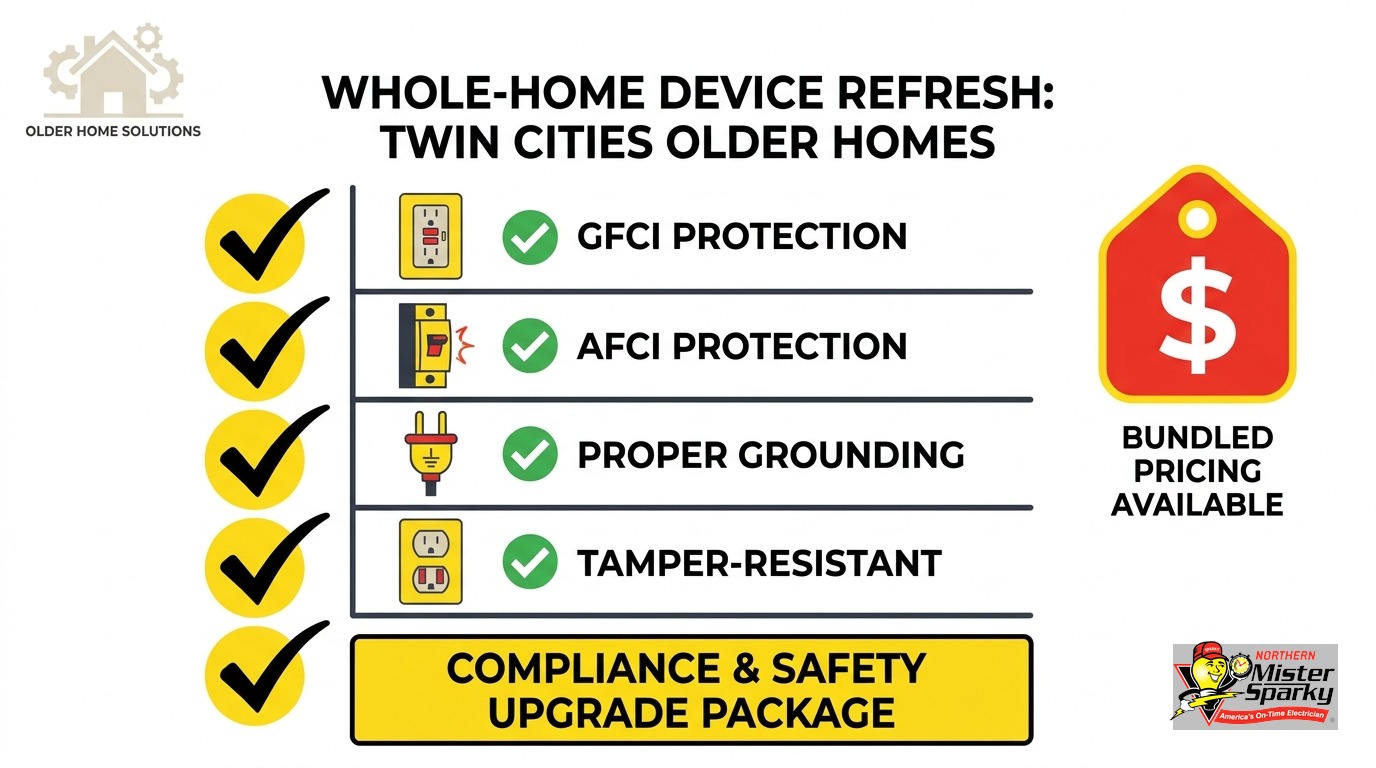
- Bundling grounding, tamper-resistant, and GFCI work into one visit lowers the per-device cost.
- New Minnesota permits now fall under the 2026 National Electrical Code (NEC).
- Your local inspection authority decides how permits work in your city.
- Ask every contractor for a written, itemized scope, not just a per-outlet price.
- Call 763-200-5956 to book a whole-home walkthrough and a clear quote.
The Short Answer
The wiring behind your devices sets the price more than the devices do. Swapping worn outlets and switches is the easy part. Grounding, ground-fault protection, and tamper-resistant devices change the scope. In older Twin Cities homes, those upgrades often set the final price.
We do not print one flat number here. A fair price needs a look at your home. Online averages come from national data and skip Minnesota homes, codes, and winters. Below, you will see what moves a quote up or down, how bundling saves money, and what the rules say about permits.
For a written quote, call 763-200-5956 or book online. We are a locally owned and operated Twin Cities electrician. We price the job after we see your panel, your boxes, and your wiring.
What drives the cost to replace outlets and switches in a whole house?
Four things drive the price: how many devices you have, which type each location needs, how easy the wiring is to reach, and what the wiring looks like inside each box. Labor usually outweighs parts. Older homes add time because grounding and box conditions vary from room to room.
Here is how each factor plays out in a real house.
- Device count. A bungalow with 40 devices is a smaller job than a two-story with 120. Count every outlet, switch, dimmer, and plate.
- Device type. A basic outlet costs far less than a GFCI outlet, a USB outlet, or a smart dimmer. Type changes the parts bill and the install time.
- Wiring condition. Brittle or cracked insulation slows the work. Sometimes it stops the swap until the wire is repaired.
- Box condition. Crowded, shallow, or damaged boxes take longer. Plaster and lath walls make every repair harder.
- Grounding status. A grounded circuit is a quick swap. An ungrounded one needs a plan.
- Access. Finished basements, tight closets, and furniture-heavy rooms add minutes to every stop.
None of this shows up in a per-outlet price you see online. Two homes with the same device count can get very different quotes for that reason.
Twin Cities homes show a pattern. A house built before the 1960s often mixes eras. One room has newer wire, and the next has old cloth-covered cable. Our guide to cloth wiring hazards in older homes explains what we look for and why it matters before any device goes on.
A swap on bad wire saves nothing. You end up with a risk behind a new cover plate.
Why do older Twin Cities homes cost more to refresh?
Older homes cost more because their wiring was built to older rules. Many have two-prong circuits with no ground wire, brittle insulation, small plaster-and-lath boxes, and a patchwork of past repairs. Each surprise adds labor. The house is fine. It just needs more careful work.
Minneapolis and St. Paul have plenty of homes from the early and middle 1900s. Suburbs like Bloomington, Brooklyn Park, and Blaine have decades of additions and remodels. Every era left its mark on the walls.
Here is what we often find behind the plates:
- Two-prong outlets that were never grounded.
- Three-prong outlets that look grounded but have no ground wire behind them.
- Old switches with cracked housings or loose, noisy contacts.
- Boxes stuffed with splices from past projects.
- Plaster walls that crack if a box is pulled the wrong way.
- Garage and basement outlets with no ground-fault protection.
The second item deserves a closer look. A three-prong outlet on an ungrounded circuit gives a false sense of safety. The plug fits, but the safety path is missing. Our post on ungrounded outlets in an older home shows how we test for this.
Winter makes it worse. Minnesota basements and garages swing from damp to dry to freezing. Outlets there see hard use and moisture, so the devices wear out faster. Those are also the places where ground-fault protection matters most.
What does a grounding upgrade involve?
Grounding is wiring work, and a device swap cannot do it. A ground wire gives stray current a safe path back to the panel. If your circuit has no ground wire, a new outlet cannot create one. The fix depends on how your house is wired and which option the code allows.
Here are the common paths, from simplest to most involved.
- Confirm the circuit is already grounded. Some outlets are grounded but have a two-prong device. We test, then swap in a proper device. This is the cheapest case.
- Add GFCI protection where code allows. On some ungrounded circuits, a GFCI device adds protection even without a ground wire. When code permits this, the devices are labeled to show there is no equipment ground.
- Run a new ground or a new cable. In accessible areas, we can pull a new cable for the circuit. It costs more but gives a true ground.
- Rewire the circuit or the house. For failing wire, a bigger plan makes sense. Our cost to rewire a house in the Twin Cities post covers when this makes sense.
The right path varies by circuit, and one house can use all four. We check each circuit with a tester and then explain the options. You do not have to guess.
For more on how grounding works, read our electrical grounding service page and our guide to replacing two-prong outlets with three-prong. Both explain what a real ground looks like and why a cheater plug does not count.
One point needs to be plain. We will not promise a grounding fix by phone, because we have not seen your wire. Anyone who quotes a ground fix sight unseen is guessing.
Where do tamper-resistant and GFCI devices fit in?
Tamper-resistant (TR) outlets have built-in shutters that block objects from the slots. GFCI devices cut power fast when current leaks to ground, which protects you from shock. Both are common upgrades during a refresh. Which rooms need them depends on current code, and we check that for each location.
They are two different safety features.
- Tamper-resistant outlets protect kids. The shutters open only when a plug presses both slots at once. Our post on tamper-resistant outlets and child safety explains how they work.
- GFCI outlets protect everyone. They watch for current leaking out of the circuit and trip in a fraction of a second. See our GFCI outlet requirements explained for where they belong.
Code on both topics has grown over the years. Minnesota’s Board of Electricity adopted the 2026 NEC with an effective date of Aug. 17, 2026. Permits filed before that date follow the 2023 NEC. Permits filed on or after it follow the 2026 NEC.
Today is late 2026, so new permits fall under the 2026 NEC. We follow the current edition on every job. We check the text for each room rather than rely on memory or an old rule of thumb.
In practice, kitchens, baths, garages, basements, laundry areas, and outdoor spots are the usual GFCI places. Bedrooms, living rooms, and hallways are common spots for tamper-resistant devices. Rules differ by room and by whether the work is new or a replacement. A whole-home walkthrough beats a guess.
Each upgrade moves the price. A GFCI device costs more than a basic outlet, and a tamper-resistant outlet costs a little more. Neither is a huge jump per device. Across a whole house the total adds up fast, which is where bundling comes in.
Why does bundling everything into one visit save money?
Most of the cost is setup, not parts. We shut off power, test each circuit, open boxes, and verify results. Doing grounding, tamper-resistant, and GFCI work in the same visit spreads that setup across every device. You pay for it once instead of three times.
Consider the alternative. You hire someone to swap two-prong outlets this year. Next year, you add GFCI protection in the basement. The year after, you replace bedroom outlets for the grandkids. That is three trips, three setups, and three rounds of patching.
One visit changes the math:
- One walkthrough. We map every circuit and device once.
- One round of power shutoffs. You lose power to a section at a time, not over and over.
- One test pass. We verify grounding and ground-fault protection at the end.
- One set of patching and cleanup. Plaster and paint repairs happen together.
- One written scope. You know exactly what changed and where.
Most online price lists show each device on its own line. They miss what happens when the work is combined. A whole-home quote can look different from a stack of per-device numbers for that reason.
Bundling also helps you plan. We sort the house into groups: urgent safety fixes, code-driven upgrades, and nice-to-haves like USB outlets or dimmers. You pick what goes in this round, and we keep the rest on the list.
If you are also thinking about a larger project, ask us about it at the same time. A panel upgrade, a new circuit, or an EV charger can share the same visit. Financing is available for larger jobs, and we are happy to walk through options.
How much do electricians charge to install a new outlet?
A new outlet costs more than a replacement because it needs new wire, a new box, and often a hole in the wall. Price depends on the distance to power, the wall type, and the circuit. We quote after seeing the site. Our cost-to-add-an-outlet guide breaks down the pieces in detail.
Replacing an outlet and adding one are different jobs. Many price lists blur the two.
- A replacement swaps a device in an existing box on existing wire. It is the faster job.
- A new outlet adds a box, runs cable from a nearby source, and patches the wall. It takes much longer.
- A new outlet on a new circuit adds breaker work at the panel. It takes longer still.
For numbers and context, start with our guide to the cost to add an electrical outlet. For a wider view of what electricians charge in this market, see how much an electrician costs in Minneapolis.
Our outlet installation service page lists what we handle, from single outlets to full-room additions. If you need to fix a dead or loose outlet instead, check our outlet repair service.
We price by the job, not by the hour. You see the number before we start, and it does not creep up. That is our no malarky approach.
Can I replace a power outlet myself?
In many cases, yes. Minnesota rules treat replacing a defective receptacle as minor repair work. But a safe swap needs power off, a tester, sound wire, and the right device. If you find no ground, burned wire, or a crowded box, stop and call a licensed electrician.
Minnesota’s rules define minor repair work as “the adjustment or repair or replacement of worn or defective parts of electrical equipment and replacement of defective receptacle outlets and manual switches for lighting control.” That is the legal basis for a simple swap.
The same rule draws a line on the other side. Maintaining and repairing wiring “does not include the installation of new wiring, apparatus, and equipment or additions, alterations, or extensions to existing wiring, apparatus, or equipment.” In plain terms, a like-for-like swap is one thing. An upgrade or a new run is another.
Our post on the homeowner electrical permit exemption in Minnesota explains what the law lets a homeowner do on their own home. Read it before you grab a screwdriver.
A DIY swap is reasonable when:
- You can shut off the right breaker and confirm power is off with a tester.
- The box has a ground wire, and the wire looks healthy.
- The new device matches the old one in type and rating.
- The work is a single outlet, not a whole house.
Stop and call us when:
- The outlet has two wires and no ground.
- The wire insulation is cracked, cloth-covered, or crumbly.
- The box is warm, scorched, or smells like burning. See our post on burning smells from an outlet or breaker.
- You want to add grounding, GFCI, or new circuits.
- The job covers a whole room or the whole house.
A whole-house refresh is long, repetitive work, and mistakes repeat. One missed ground or reversed wire can sit behind a wall for years. A trained eye pays for itself there.
Do I need a permit for outlet work in Minnesota?
It depends on the work and your city. Replacing a receptacle with an identical device is generally treated as minor repair. Adding grounding, GFCI protection, or new wiring is an alteration, and it is treated differently. Check with your inspection authority before you start, and ask us how we handle it.
This is where quotes get confusing, so let us slow down.
DLI’s minor repair bulletin reportedly lists replacing receptacle outlets with devices of identical characteristics as work exempt from mandatory inspection. Exempt from inspection does not mean exempt from safety standards. The device and the wiring still have to be safe.
On the city side, Minnesota rules say a municipality should not require a permit for work that is exempt from inspection. Cities still have their own habits and bulletins, so confirm with yours.
Now the other side. Adding GFCI protection, changing a circuit, or adding grounding goes beyond a like-for-like swap. Treat those as alterations. A permit may apply, and an inspector may need to look at the work.
Who inspects? DLI’s homeowner page tells you to check the Authority Having Jurisdiction (AHJ) in the electrical inspector directory. If the AHJ column says “State,” you file with the state. If it says “Local,” you contact the city or township. Homeowners pay permit fees through their online account, and the page gives a 10-day payment window.
Minneapolis and St. Paul do not run permits the same way. Our post on Minneapolis and St. Paul permit and inspection differences walks through the gaps. For the basics, read our Minnesota electrical permit guide.
When we do the work, we handle this for you. We tell you up front if a permit applies. We pull it, schedule the inspection, and meet the inspector. We do not promise whether a bundled upgrade needs a permit before we know your scope and your city. We confirm with the authority first.
Unpermitted work can cause trouble later. It can come up at a home sale or an insurance claim. See unpermitted electrical work when buying a home in Minnesota for what that looks like.
What does a whole-home device refresh look like with us?
It starts with a walkthrough and ends with a tested house. We map every outlet and switch, test grounding and ground-fault protection, and give you a written scope with a price. Then we work room by room, patch as needed, and verify every device before we leave.
Here is the usual flow.
- You call or book online. Call 763-200-5956, or pick a time on our site. Scheduling is fast.
- We walk the house. We count devices, test circuits, and open sample boxes. We note anything that needs repair before a swap.
- We write the scope. You see which devices change, where grounding or GFCI is needed, and what is optional.
- We give you a price. It is itemized and in writing, with no surprises on the day.
- We confirm permits. If your work needs one, we handle it with the right authority.
- We do the work. We shut off power in sections and protect your floors and furniture.
- We test everything. Every device gets a check for grounding, polarity, and ground-fault protection.
- We walk you through it. You see what changed, and you get a record for your files.
We show up on time. That is the promise behind America’s On-Time Electrician(R). Our UWIN(R) 100% satisfaction guarantee means you get a fix if something is not right.
We are locally owned and operated, and we live through the same cold winters you do. We know what a Minnesota basement does to an outlet. We know what a 1920s plaster wall does to a repair. That experience goes into every quote.
Many homeowners pair a refresh with other safety work. Ask us about hardwired smoke detector replacement or a whole-home surge protection plan. Both fit into the same visit.
Compare Quotes Fairly
A low per-outlet price can hide a thin scope. To compare quotes, line up what each one includes: device type, grounding, GFCI, permits, patching, and testing. A quote that skips these items looks cheaper only because it is incomplete.
Use this checklist when you collect bids:
- Device count. Does the quote list how many outlets, switches, and dimmers?
- Device type. Does it name tamper-resistant, GFCI, and USB devices?
- Grounding plan. Does it say what happens on two-prong circuits?
- Permits. Does it say who pulls the permit and who pays for it?
- Patching. Is wall and plaster repair included or extra?
- Testing. Does the contractor test and document every device?
- License. Is the contractor licensed in Minnesota? Our post on how to verify a licensed electrician in Minnesota shows how.
- Warranty. Is there a written guarantee on the work?
Be careful with phone quotes. No one can price grounding without seeing the wire. If a number comes too fast, ask what it leaves out.
Ask about the order of work too. A good plan fixes safety problems first. Those include scorched devices, no ground in wet areas, and missing ground-fault protection. Cosmetic upgrades come after.
Timing affects price. Spring and summer are busy for electricians. Fall and winter can be a good time to book indoor work. Ask us what our calendar looks like.
If you are weighing a bigger project, the same visit can cover it. A panel upgrade can pair well with a device refresh, and financing can help spread out larger jobs. Our panel upgrade service page has the details.
Next Step: Get a Clear Number for Your Home
Whole-house outlet and switch pricing comes down to device count, wiring condition, grounding, and code. Once you see your own home’s details, you can plan for it.
We make that easy. We walk your house, test your circuits, and explain your options in plain English. You get a written, itemized quote. You choose what to do now and what can wait.
Start before a warm outlet or a tripped breaker forces the issue. A planned refresh costs less and stresses you less than an emergency call.
Call us at 763-200-5956 or book online. We serve Minneapolis, St. Paul, Bloomington, Brooklyn Park, Woodbury, Blaine, Maple Grove, Plymouth, and nearby Twin Cities neighborhoods. We are a locally owned and operated team, and we will give you a straight answer.
Need HVAC or plumbing help while we are at it? We stick to electrical work. Our sister brands, Northern One Hour HVAC and Northern Benjamin Franklin Plumbing, cover those services.
Frequently Asked Questions
Do I need an electrician to replace an outlet? +
Should I replace all my outlets at once or one room at a time? +
Does a whole-house device refresh fix ungrounded outlets? +
Need an electrician now?