
Outlet Too Loose Plug Falls Out? Why to Replace It
Key Takeaways
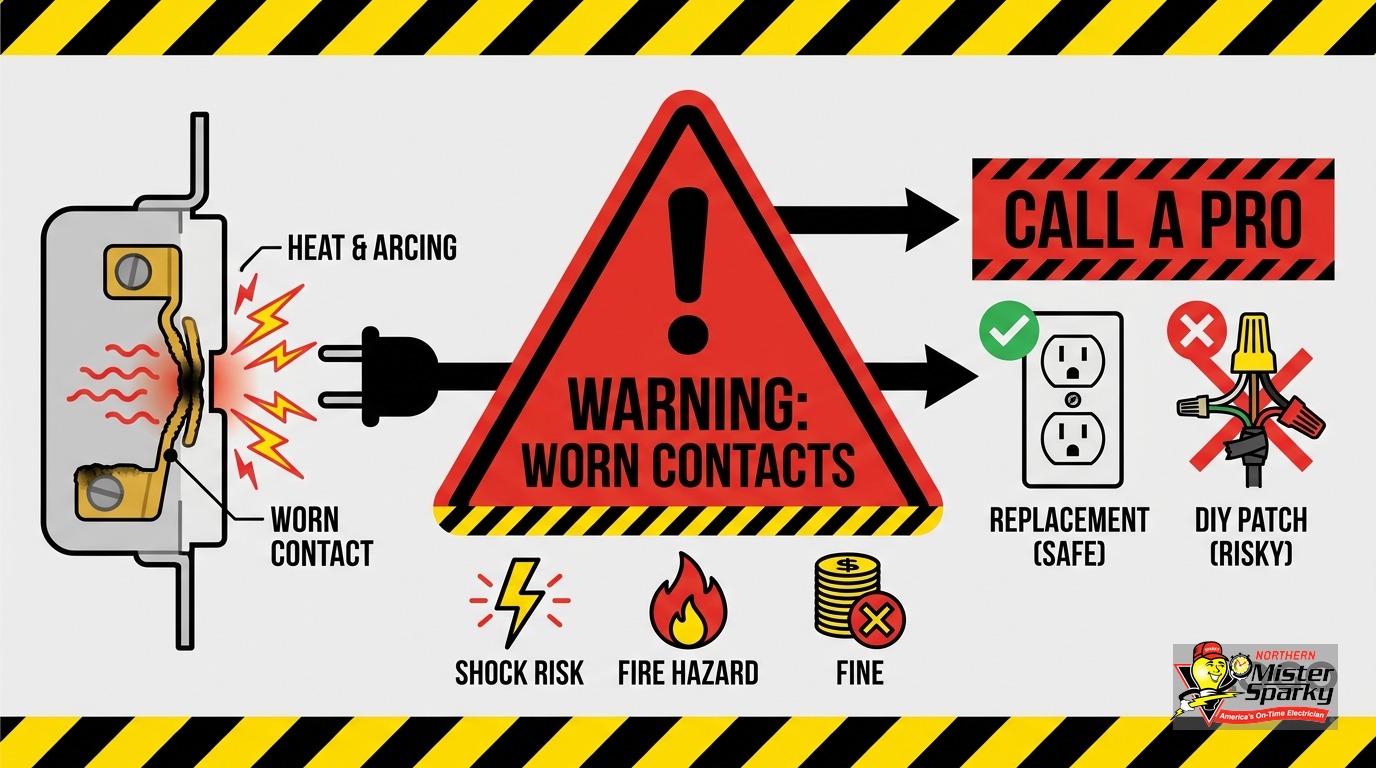
- A plug that falls out usually means the outlet’s metal contacts are worn and no longer grip the blades.
- Poor contact adds resistance, and resistance turns electricity into heat at one small spot.
- Two different problems cause loose plugs: worn contacts (replace the outlet) and a loose mounting or loose terminal screws (tighten or shim).
- Bent prongs, plug stabilizers, tape, and wedges hide the symptom. They do not fix it.
- Warmth, discoloration, buzzing, a hot-plastic smell, or sparks mean stop using the outlet right away.
- Replacing a receptacle is a small job, but permit rules vary by city. Minnesota now falls under the 2026 NEC.
- Call 763-200-5956 or book online. We are America’s On-Time Electrician(R), and every job carries our UWIN(R) 100% satisfaction guarantee.
Outlet Too Loose and the Plug Falls Out? The Short Answer
If a plug will not stay put, the outlet is worn out. Replace the receptacle. That is the fix that works, and it is usually a quick job for a licensed electrician.
The metal contacts inside the outlet have lost their grip. A weak grip means poor contact, and poor contact makes heat. That heat builds in a tiny spot behind the faceplate, where you cannot see it.
We are Northern Mister Sparky, a locally owned and operated electrician serving the Twin Cities. We see worn outlets in every kind of home, from 1920s bungalows in St. Paul to newer builds in Woodbury and Maple Grove.
Why Would a Plug Fall Out of an Outlet?
A plug falls out when the metal contacts inside the outlet no longer squeeze the blades tightly. Springy metal fatigues after years of plugging and unplugging. A device that has shifted in its box, or loose terminal screws, can also cause it. Each cause needs a different fix.
Behind each slot sits a pair of spring-metal contacts. They pinch the plug blade from both sides. When the metal is new, that pinch is firm. You feel it when you push a plug in.
Over time, three things wear that pinch down:
- Repeated use. Every plug and unplug flexes the metal a little. A kitchen counter outlet or a bedside outlet gets used thousands of times.
- Heavy plugs and cords. A heavy adapter, a power strip, or a cord that pulls sideways stresses the contacts. They spread slightly and stay that way.
- Heat. Warm contacts lose their springiness. Once the metal softens, it never fully recovers. The next section covers how that cycle feeds itself.
Age matters too. Many Twin Cities homes built decades ago still have their original outlets. Some are simply tired.
There is a second, separate cause. Sometimes the contacts are fine, but the whole outlet wobbles in the wall. Or the wires are loose on the screws behind it. We explain how to tell these apart below.
Why Does a Loose Plug Get Hot?
A loose contact makes electricity squeeze through a smaller touching area. That adds resistance, and resistance turns current into heat at one small spot. Heat then softens the metal and plastic, which loosens the grip more. Higher-draw devices like space heaters make the effect worse.
Picture a garden hose with a pinched spot. Water still flows, but the pinch takes the strain. In an outlet, the pinch is the poor contact. The strain shows up as heat.
The heat grows with the load. A phone charger draws very little current. A space heater, hair dryer, or window air conditioner draws a lot. A loose outlet feeding one of those is the worst case.
What the lab evidence shows
Benfer and Gottuk published a study through the International Association for Fire Safety Science. They ran 408 trials of receptacles with various terminal connections. The receptacles were powered for up to 16 months.
The authors found that only very loose connections (less than 0.339 N-m, or 3 in-lb) at moderately high currents (9A or higher) tended to form significant overheating connections and receptacle failures.
That is good news and a warning at once. Most slightly loose connections did not fail. But very loose ones carrying real load did.
Two details matter for your home:
- This study tested screw terminals. It measured how tightly wires were fastened to the outlet. It did not measure worn blade contacts directly. We cite it to show how loose connections behave in general, not to claim it measured your worn slots.
- Failure can be slow. The authors report that a small portion of receptacles with loose connections overheated to the point of failure, some including flaming events. Those failure events occurred between 5 and 365 days after tests were started.
That timing explains why a bad outlet can look fine for months. Nothing seems wrong. Then one day it is hot, or worse.
Why arcing enters the picture
Arcing is a small electrical spark that jumps a gap. A loose contact can create tiny gaps as the plug shifts or vibrates. Each spark is hot enough to pit and blacken the metal. Pitted metal conducts worse, which creates more heat.
If you see a flash or hear a snap when you plug something in, read our guide on what causes outlet sparks. A tiny blue flash can be normal. A repeated or loud one is not.
Worn Contacts or Loose Mounting: Which Problem Do You Have?
Two different problems often get blurred together. They need different fixes, so sort them out first.
Problem one: worn blade contacts
This is the classic case. The outlet is firmly mounted, but plugs slip out of one or both slots. Try a few different plugs. If every plug is loose in that slot, the contacts are worn.
The fix is simple: replace the receptacle. You cannot repair spring contacts. A published home-safety article makes the same point, noting that loose blade slots are especially hazardous and call for replacing the receptacle.
Problem two: the device is loose in the box
Here the plug grips fine, but the whole outlet rocks or sinks into the wall when you push. The mounting screws may be loose. Or the electrical box sits too deep behind the drywall, so the device has nothing to pull against.
Common causes include:
- Mounting screws that backed out over time
- A box set too far back after a tile, paneling, or drywall change
- Stripped screw holes in the device strap
- A cracked or damaged box
Some people use small plastic spacers in a recessed box. The same article says a deeply recessed box should get an electrical box extender rather than spacers. Have a pro check the fit. Depth rules come from the code, not from rules of thumb.
Problem three: loose wires behind the outlet
You cannot see this one from the front. The terminal screws that hold the wires may be loose. Or the wires may be pushed into small back holes instead of wrapped around screws. These back-hole connections are often called backstab connections. They depend on a small spring clip. Many electricians prefer screw terminals for a firmer hold.
Looking at the plug slots won’t reveal this. A warm faceplate is often the first sign. Our post on why an outlet or switch plate feels warm walks through the causes.
A quick sorting test
Do not open the wall plate for this. Just observe:
- Plugs slip out, outlet is solid: worn contacts. Replace the outlet.
- Outlet wobbles or sinks when you plug in: mounting problem. Needs a pro to tighten or shim.
- Outlet feels warm, smells odd, or buzzes: possible loose wiring. Stop using it and call us.
When in doubt, treat it as the more serious case.
What Are the Warning Signs That a Loose Outlet Is Already Overheating?
Watch for warmth at the faceplate, brown or black discoloration, a hot-plastic or fishy smell, buzzing, crackling, or sparks when you plug in. Any of these means stop using the outlet. Turn off its breaker and call an electrician. Do not wait to see if it improves.
Each sign tells you something different.
- Warm cover plate or plug. A little warmth after heavy use can be normal for a heater cord. A plug that feels hot, or a plate warm with nothing plugged in, is not.
- Discoloration. Brown, tan, or black marks around the slots point to past heating or arcing.
- Melted or warped plastic. The outlet face may look soft, bubbled, or deformed. That is advanced damage.
- Odd smells. A hot-plastic, burnt, or fishy odor needs immediate attention. See our guide on a burning smell from an outlet or breaker.
- Buzzing or crackling. Healthy outlets are silent.
- Flickering power. Lights or devices that cut in and out when you touch the plug suggest a poor connection.
A fire department in Colorado put the risk plainly. Its alert says loose connections lead to heating of plugs and outlets, which could result in a fire. Its advice was to call a licensed electrician and have it replaced.
That is a Colorado department, not Minnesota guidance. But the physics does not change at the state line.
Why fire investigators care
Overheated receptacles leave evidence. The same lab study found overheating indicators were found to persist after fire exposure. In plain terms, the damage can still be read after a fire. That shows why a loose connection is a starting point investigators look for.
Our larger guide on signs you need an electrician lists other red flags around your home.
How to Keep a Plug in a Loose Outlet?
Don’t. Bent prongs, stabilizer inserts, tape, and wedges hide the symptom while the loose contact keeps making heat. Replacing the receptacle is the only fix that restores a tight grip. Leave the outlet unused until it is replaced.
We know the temptation. A plug that keeps falling out is annoying, and a quick patch feels harmless. Here is how the common patches compare.
Bending the plug prongs outward
This is the most common trick. People spread the blades so they wedge into the slot. It can hold for a day.
The risks are real. Bent blades can crack or break off in the slot. They also scrape the contacts and wear them faster. The plug may no longer seat flat, which leaves less metal touching and adds heat. This patch makes the problem bigger.
Plug stabilizers and grip inserts
These small devices clip onto the plug or slide into the outlet to add friction. They can keep a plug from sliding out. But they add only mechanical grip. They do not restore the electrical contact. The loose, hot spot is still there.
They can also hide the warning sign. Once the plug stops falling out, you lose the one clue that the outlet was failing.
Tape, putty, and wedges
Wrapping tape around a plug or stuffing something into the slot is never safe. Tape can melt or burn. Wedges can bridge live metal. Skip these entirely.
Over-tightening a worn device
Some people crank the mounting screws to pull the outlet tight against the box. That fixes wobble. It does nothing for worn blade contacts. Overtightening can also crack the outlet body or strip the screws.
Extension cords and power strips as a workaround
Plugging a power strip into a loose outlet and moving the plug elsewhere feels like a fix. But the loose outlet is still live and still loaded. If you must stop using an outlet, put a cover over it and leave it alone. Our post on extension cord dangers explains why long-term cord use is a poor substitute for a good outlet.
The ranking
From safest to riskiest:
- Replace the receptacle. Restores a firm grip and clean contact.
- Stop using the outlet until it is replaced.
- Stabilizer inserts. Cosmetic only, and they hide warning signs.
- Bending prongs. Can damage both the plug and the outlet.
- Tape, wedges, or makeshift fixes. Never acceptable.
Replacement wins every time. Once you count the risk, it is also the cheapest fix.
How Can I Fix Loose Plugs That Fall Out of Outlets?
Replace the receptacle. A new device grips plug blades firmly again. Turn off power first, use a like-for-like device, and check the wiring and connections while the cover is off. If the box, wiring, or terminals look damaged, an electrician should handle it.
A proper replacement follows a set order.
Step by step: what a pro does
- Test and identify. We find the right breaker and confirm the power is off with a tester. We never trust the breaker label alone.
- Remove the cover and device. We inspect the wires, the box, and the old outlet. Burn marks or melted insulation show how far the damage goes.
- Check the wiring. Brittle or discolored insulation near the old connections means the wire may need trimming back to clean copper. We confirm the conductors are in good shape before reconnecting.
- Match the device. The new receptacle must suit the circuit. A 15-amp circuit and a 20-amp circuit use different devices. Our guide on the difference between 15-amp and 20-amp outlets explains why.
- Use screw terminals. We wrap wires around the screws and torque them properly. A firm connection is the whole point.
- Seat the device. We mount it flush and square. If the box is too deep, we fix that with the right extender.
- Test the new outlet. We check polarity, grounding, and grip before we call it done.
Should you also consider GFCI protection?
Sometimes the right upgrade is a GFCI outlet, especially in kitchens, baths, garages, and outdoors. That is a separate question from looseness. To compare options, see our guide on GFCI breakers versus GFCI outlets. Outdoor outlets also face cold-weather quirks, which we cover in our post on outdoor GFCI nuisance tripping in Minnesota.
When replacing one outlet is not enough
If one outlet is worn, others on that circuit may be too. Older homes often have a row of tired outlets that all got the same use. If you find several loose ones, ask us to check the whole room. A short visit now can prevent a string of repairs later.
Ready to book? See our electrical outlet repair service or call 763-200-5956.
Do You Need an Electrician to Fix a Loose Outlet?
Often yes. Some homeowners may do this work on a home they own and live in, but permit rules vary by city. A licensed electrician also checks the wiring behind the outlet, which is where hidden damage hides. If you are unsure, call before you open anything.
The honest DIY picture
Swapping a receptacle is a small job on paper. You turn off the breaker, remove two screws, move the wires, and reinstall. Plenty of people do it.
But three things make it riskier than it looks:
- Wrong breaker. Panels are often mislabeled. A wire you think is dead may be live.
- Hidden damage. Burnt insulation or a cracked box needs more than a swap.
- Shared neutrals and unusual wiring. Older Twin Cities homes sometimes have surprises behind the wall. See our post on shared neutrals for one example.
Permits in Minnesota
Permit rules for homeowner work vary by city. Some cities treat a like-for-like swap as minor repair. Others want a permit. We have not confirmed those details for every Twin Cities suburb, so we will not guess here.
Our post on the Minnesota homeowner permit exemption explains the general rules. For a specific address, check with your city or call us. A licensed electrician handles the permit question for you.
The 2026 NEC now applies
Code changes affect this work. The Minnesota Department of Labor and Industry says the Board of Electricity has adopted the 2026 National Electrical Code with an effective date of Aug. 17, 2026. Permits filed on or after that date must comply with the 2026 NEC.
That date has passed, so replacement work done today falls under the newer code. A licensed electrician keeps up with those updates. A DIY swap may not.
What a licensed pro adds
- Correct device selection for the circuit and location
- Inspection of the box and wiring while the outlet is open
- Proper torque and termination on every connection
- Code awareness for current Minnesota rules
- A workmanship guarantee. Ours is backed by UWIN(R), our 100% satisfaction guarantee.
If a worn outlet turns out to be one sign of a bigger wiring issue, we will tell you straight. No malarky, no upsell for its own sake.
A Note on Minnesota Homes and Winter Use
We do not have a study linking Minnesota’s climate to outlet wear. Treat this as field commentary, not a statistic.
In our experience, winter changes how people use their outlets. Space heaters come out. Holiday lights go up. Basement dehumidifiers and garage heaters run longer. More high-draw devices on older outlets means more stress on worn contacts.
That is a good reason to deal with loose outlets before the cold season peaks. Since it is November, now is a smart time. Our fall and winter safety check covers every room at once.
If you rely on a space heater, plug it into a firm, healthy outlet. Never use a loose one. Our guide on space heater circuit requirements explains what these devices demand.
What to Do Right Now
If a plug in your home keeps falling out, follow this plan:
- Stop using that outlet for anything heavy, especially heaters and appliances.
- Check for warning signs. Feel for warmth and look for marks or odd smells.
- Turn off the breaker if you see discoloration, smell something, or hear buzzing.
- Skip the patches. Do not bend prongs or add inserts.
- Call a licensed electrician to replace the receptacle and check the wiring.
If a room has several loose outlets, mention that when you call. We can plan the visit to handle them together.
Why Call Northern Mister Sparky
We are locally owned and operated, and we live and work in the Twin Cities. We serve Minneapolis, St. Paul, Bloomington, Brooklyn Park, Woodbury, Blaine, Maple Grove, Plymouth, and nearby communities.
Here is what you can expect:
- On-time arrival. We are America’s On-Time Electrician(R) for a reason.
- Clear answers. We explain what we find in plain language.
- Honest options. We tell you when a simple swap is enough.
- A satisfaction promise. Our UWIN(R) guarantee means we stand behind the work.
We handle electrical work only. For heating, cooling, or plumbing questions, our sister brands, Northern One Hour HVAC and Northern Benjamin Franklin Plumbing, can help.
Call 763-200-5956 or book online, and we will get a technician to your door fast.
Frequently Asked Questions
How long can a loose outlet go before it fails? +
Is a loose outlet a fire hazard? +
Can I just tighten the screws on a loose outlet? +
Should I keep using a loose outlet for low-power items? +
Need an electrician now?