
Xcel Energy Demand Response Program Home Setup Guide
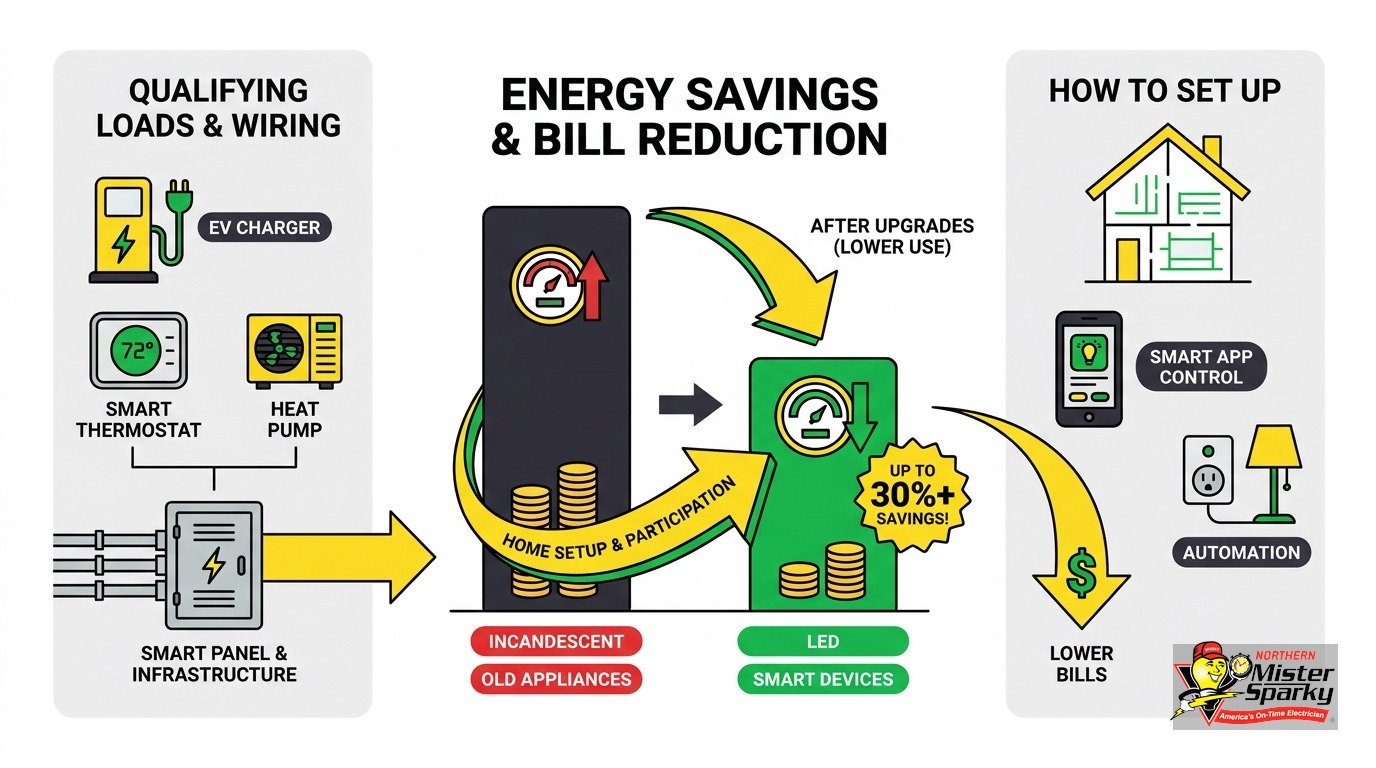
Key Takeaways
- Demand response pays you to use less power when the grid is stressed, usually on hot summer afternoons and evenings.
- Xcel’s AC Rewards needs central air, an eligible thermostat, and Wi-Fi. Apartments, condos, and mobile homes are not eligible.
- A smart thermostat often needs a C-wire. Older systems may need a wiring fix first.
- EV chargers, electric water heaters, and heat pumps are the big loads. Each one needs panel room and often a permit.
- Time of Use pricing is optional. It rewards you for shifting use out of the 6 p.m. to 9 p.m. weekday peak.
- Dollar amounts differ between sources. Confirm current credits and rebates with Xcel before you decide.
- Call Northern Mister Sparky at 763-200-5956 or book online for a pre-enrollment check.
How do you get your home ready for Xcel Energy’s demand response programs?
Start with three checks: what you own, what wiring it needs, and whether your panel has room. Your central air conditioner, thermostat, Wi-Fi, and any EV charger or electric water heater decide which program fits. Then an electrician confirms the wiring and permits before you enroll.
Most homeowners treat demand response as a thermostat purchase. For many Twin Cities homes, it is also a wiring question.
We are Northern Mister Sparky, a locally owned and operated electrician serving the Twin Cities. We see the electrical side of these programs every week.
What is demand response, and why does Xcel pay for it?
Demand response means you agree to trim your power use during peak demand. In return, you get bill credits or lower rates. The utility avoids buying expensive peak power or building new plants. You get a smaller bill for easing the strain on the grid.
Xcel has run these programs in Minnesota for years. One news report says Xcel’s demand response capability was 850 megawatts in 2017, about 10% of system peak. The same report says Saver’s Switch has enrolled more than 60% of homeowners with air conditioning.
The loads involved are growing. The report lists central air conditioners, customer batteries, electric vehicles, and grid-connected appliances. The more electric equipment you add, the more your wiring and panel matter.
Most guides skip one point. Programs say what you must own. They rarely say what your house must have behind the wall.
Which Xcel program fits your home?
Match the program to the equipment you already own. Saver’s Switch suits homes with a programmable thermostat and central air. AC Rewards suits homes with a Wi-Fi smart thermostat. Time of Use suits homes that can shift big loads, like EV charging, to overnight hours.
Here is how the options compare in plain terms.
Saver’s Switch. Xcel cycles your air conditioner during peak events. MnCEE says Saver’s Switch needs a programmable thermostat and is free to enroll. In Minnesota, these programs typically run June through September.
AC Rewards. This program uses your own smart thermostat. According to the program FAQ, you need central air, an eligible thermostat, and Wi-Fi. Apartments, condominiums, and mobile homes are not eligible.
Time of Use. This is a rate, not a switch. You pay more during a short evening peak and less overnight. It is optional.
EV off-peak rate. This is a separate rate for EV owners. It can involve extra metering hardware, so it is an electrician job. We cover it below.
You cannot stack everything. The FAQ says Saver’s Switch participants cannot join AC Rewards without giving up the switch and its credits. Pick the program that matches your habits.
What loads qualify for demand response?
Central air conditioning is the main load. Xcel’s thermostat programs target it directly. Other loads, like EV chargers, electric water heaters, and heat pumps, benefit through rates or smart controls. They matter because they are your biggest electric draws.
Think of your home in four groups.
Central air conditioning
This is the load that qualifies for AC Rewards and Saver’s Switch. Window units and portable units do not count. If you have a mini-split, the program rules differ, so ask Xcel first. Our mini-split circuit guide explains what those systems need electrically.
EV chargers
A Level 2 charger is often the largest single load added to a home. It is also the easiest to shift. Most cars can wait until after midnight to charge. That makes a charger a strong fit for Time of Use pricing.
If you are planning one, read our guide to EV charger installation in the Twin Cities. Our EV charger service page lists what we install.
Electric water heaters
A tank water heater runs on a schedule. Heating water overnight costs less under a Time of Use rate. Heat pump water heaters use less power but still need the right circuit. See our heat pump water heater circuit guide.
Heat pumps and electric heat
The Public Utilities Commission also approved an optional winter space-heating rate. According to CUB Minnesota, the rate is 6.537 cents per kilowatt-hour in winter. It is for heat pump and baseboard users. Equipment sizing belongs to our sister company, Northern One Hour HVAC. We handle the electrical circuit and disconnect.
What wiring does a smart thermostat need?
Most smart thermostats need a steady power wire, called a C-wire. Without one, the thermostat may reboot, drop Wi-Fi, or fail to join a program. Many newer homes have it. Many older homes do not. A quick look behind the thermostat tells you.
Here is what we check on a typical visit:
- Wire count. Four or five wires at the thermostat usually means a C-wire is present or easy to add.
- System type. Old two-wire and millivolt systems need different parts than standard low-voltage systems.
- Power source. We confirm the low-voltage transformer is healthy and sized right.
- Wi-Fi at the thermostat. Programs need a live connection. A weak signal in a hallway is a common failure point.
Check your thermostat’s installation guide for its exact wiring needs. Each model differs, and we do not guess.
Our full guide to smart thermostat C-wire wiring walks through the options. If your system is a gas furnace with central air, the furnace board holds the other end of that wire. Our furnace wiring and disconnect guide covers that side.
Look at the outdoor unit too. A damaged or missing disconnect near your condenser is a safety problem. It also stops a clean service call. See our AC condenser disconnect requirements.
Can a smart thermostat rebate help pay for the upgrade?
Yes, for eligible models. The AC Rewards FAQ lists a $50 instant rebate on eligible thermostats bought at the Xcel Energy Store. For other retailers or contractor installs, you mail in a dated invoice. The deadline is September 30 of the year after installation.
Checks take about eight weeks, per the same page. Keep your invoice. If an electrician installs the thermostat, ask for an itemized receipt that names the model.
One caution: the FAQ says the existing-thermostat incentive appears only in the terms and conditions. Read those before you assume you qualify. Our overview of Xcel Energy electrical rebates in Minnesota tracks other offers.
What does an EV charger or second meter socket require?
An EV charger needs its own dedicated circuit sized for the charger. Xcel’s EV rate can add metering hardware on top of that. That work involves your meter socket, so it needs a licensed electrician and the utility’s sign-off. We confirm current Xcel requirements before we quote.
We do not quote Xcel’s set-up numbers here. The details change, and we have not verified them against the current document. When you call, we pull the latest version for your address.
Here is how the work breaks down:
- Circuit and breaker. The charger needs a dedicated breaker and wire sized for its amperage.
- Outlet or hardwire. A plug-in charger uses a 240-volt outlet. A hardwired unit connects straight to the circuit.
- Metering. Some rate plans add a meter or socket. That changes the service equipment.
- Inspection. Meter and service changes usually need a permit and an inspection.
Our guide to EV charger amperage selection helps you pick the size. If you are weighing wall outlets, read about NEMA 14-50 outlet installation cost. For a detached garage, see our subpanel guide for EV chargers.
Does your electrical panel have room for the extra load?
Often it does, but do not guess. A panel has a fixed amount of capacity and a fixed number of slots. Adding a charger, a water heater, or a heat pump uses both. A load calculation tells you whether you have headroom.
Signs your panel is close to its limit:
- Breakers trip when two big appliances run together.
- Lights dim when the air conditioner starts.
- The panel has no open slots.
- The panel is old, or it is a brand with a known history of problems.
A load calculation adds up your real demand and compares it to your service size. Our guide to home electrical load calculations explains the math in plain terms. If you are already at the limit, a panel upgrade may be the right fix.
Many Twin Cities homes still run 100 amp service. That may be fine for a small house with gas heat. It gets tight with an EV and a heat pump. Our comparison of 100 amp vs. 200 amp service can help you decide.
An upgrade is not always required. Smart load management can share power between a charger and other big loads. Read how it works in our guide to EV load management without a panel upgrade.
If you do need a bigger service, the utility is part of the job. Xcel has to pull and reset the meter. Our walkthrough of the Xcel meter pull and panel upgrade process shows what to expect.
How do you choose a smart panel for home energy management?
Choose a smart panel by matching its features to your actual loads. Look for circuit-level monitoring, remote control of big loads, and room for expansion. Then confirm it fits your service size and your local utility rules. A smart panel only helps if your wiring is sound.
A smart panel does two jobs. It shows you what each circuit uses. It can also switch or limit loads for you. That helps with demand response because the panel can pause a charger or water heater during a peak window.
Ask these questions before you buy:
- How many circuits does it monitor? Full coverage beats a few clamps on the biggest loads.
- Can it control loads, or only watch them? Control is what lets you automate peak-hour savings.
- Does it work with your battery or solar plans? Plan now if you may add either later.
- What is the real installed cost? Hardware is only part of it. Labor, permits, and any service upgrade add up.
- Will the utility accept the setup? Rate programs have their own rules for metering and controls.
Do not buy a smart panel just to join a program. The standard programs run on a thermostat. A smart panel pays off when you have several large loads and want finer control.
For pricing and options, read our guide to smart electrical panel upgrade cost. If you only want to see where your power goes, a whole-home energy monitor costs less and installs faster.
Does Time of Use pricing save money in a Twin Cities home?
It can, if you can move big loads out of the evening peak. It can cost you if you cannot. The rate is optional, so nobody forces you into a bad deal. Look at your own usage pattern before you opt in.
The rate design is simple. According to CUB Minnesota, peak is 6 p.m. to 9 p.m. on non-holiday weekdays. Off-peak runs from midnight to 6 a.m. daily. In summer, peak costs 2.7 times the off-peak price. Summer means June through September.
Press reports describe the rollout. According to Hoodline, enrollment is gradual and tied to smart meters. Customers get notices 30 and 15 days before enrollment. They can opt out with 30 days’ notice.
Who tends to win:
- EV owners who charge overnight.
- Homes with electric water heaters on a timer.
- Households that can run laundry and dishes after 9 p.m.
Who tends to lose:
- Families home on weekday evenings, cooking and running the air conditioner.
- Homes that cannot shift any large load.
Our guide to Time of Use rate electrical upgrades goes deeper on the equipment side. If winter bills worry you, see our winter energy efficiency upgrades.
How much can you actually save?
Savings vary by home. One source says you could save as much as 15 percent on summer bills. That is a ceiling, and your result depends on your equipment, your habits, and the weather.
Sources disagree on dollar credits. News reports and program pages quote different enrollment bonuses and annual credits. We do not repeat those figures here, because they change. Ask Xcel for the current numbers in writing before you commit.
Here is how we think about the total picture:
- Program credits. These are small and seasonal. They cover a coffee habit, not a vacation.
- Rate savings. Shifting EV charging and water heating can add up over a year.
- Rebates. A thermostat rebate trims the upfront cost.
- Efficiency. Fixing root problems, like leaky ducts or failing wiring, lowers your bill every month.
If your bill is already high for no clear reason, look there first. Our guide to electrical causes of high bills lists the usual suspects. Demand response trims the peak. It does not remove waste.
Do you need a permit for this work?
A thermostat swap usually does not need one. New circuits, meter sockets, panel work, and service changes usually do. Rules depend on the job and the city. We pull permits as part of our work, so we handle the inspection.
Minnesota requires a licensed contractor for most electrical work like this. Verify any electrician before you hire. Our guides cover Minnesota electrical permits and how to verify a licensed electrician.
Skipping a permit can cost you later. Unpermitted work can surface during a home sale or an insurance claim. Our post on open permits at home sale explains the risk.
A permit protects you, and it protects whoever buys your house next.
What does a pre-enrollment electrical visit include?
We walk through your home, check the equipment, and give you a plain-language plan. You leave knowing which program fits, what wiring work is needed, and what it costs. No pressure, and no malarky.
Here is the typical flow:
- Equipment review. We note your air conditioner, thermostat, water heater, EV plans, and heating type.
- Thermostat wiring check. We confirm wire count, C-wire status, and Wi-Fi strength.
- Panel review. We check service size, open slots, and the condition of the panel.
- Load estimate. We total your demand with any planned additions.
- Program match. We help you compare Saver’s Switch, AC Rewards, and Time of Use for your home.
- Written quote. You see the scope, permits, and price before work starts.
Larger jobs, like a panel upgrade, a charger, or a generator, can be expensive. Ask us about financing options when you book.
If your visit turns up a safety issue, we tell you plainly. Old panels, damaged wiring, and missing grounds come first. See our electrical grounding service and our list of the top electrical hazards.
Why should you hire a local electrician for this?
The work sits between your house and the utility, and local knowledge saves time. We know Twin Cities permit offices, Xcel’s processes, and the older housing stock here. We answer to neighbors, not a distant head office.
Northern Mister Sparky is locally owned and operated. We are backed by the national Mister Sparky brand, so you get consistent standards. We are America’s On-Time Electrician(R), and we back our work with the UWIN(R) 100% satisfaction guarantee.
Safety is the reason this post sits in our Safety category. Demand response adds new loads, new controls, and new wiring. Done right, it is safe and invisible. Done wrong, it overloads circuits and hides problems until a breaker trips or worse.
Know your loads, check your wiring, and give your panel room to breathe. Then the program does its quiet work each summer.
Ready to get your home set up?
Call Northern Mister Sparky at 763-200-5956 or book online. We will check your thermostat wiring, review your panel, and tell you which Xcel program fits. If your home needs more capacity, we will explain your options and financing in plain English.
Serving Minneapolis, St. Paul, Bloomington, Brooklyn Park, Woodbury, Blaine, Maple Grove, Plymouth, and nearby Twin Cities communities.
Frequently Asked Questions
Can renters or condo owners join Xcel's AC Rewards? +
Do I have to give up Saver's Switch to join AC Rewards? +
Is Xcel's Time of Use rate required? +
Will a smart thermostat work with my old heating and cooling system? +
Should I call an electrician before I enroll? +
Need an electrician now?