
Dishwasher Electrical Requirements in Minnesota Homes
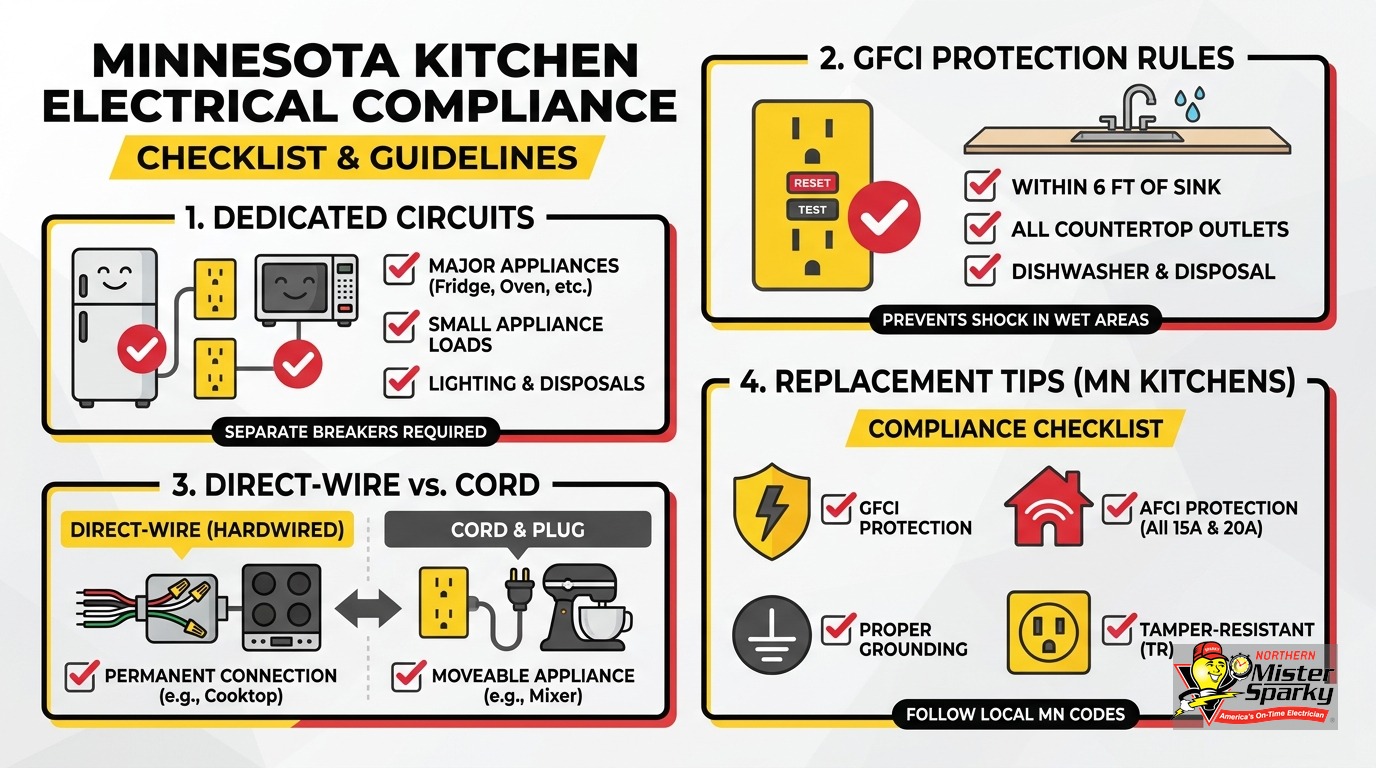
Key Takeaways
- A standard built-in dishwasher runs on a dedicated 120-volt circuit, not 240 volts.
- One home inspection firm calls for a 20-amp breaker with 12 AWG copper wire. Check your unit’s nameplate to confirm.
- Every dishwasher needs a grounding path. A missing ground is a safety problem.
- Minnesota adopted the 2026 NEC effective Aug. 17, 2026. Permits filed on or after that date follow it.
- Kitchen GFCI rules are broad under the 2023 NEC. Ask a licensed electrician how they apply to your unit.
- Old shared circuits, loose cords, and tight cabinet spaces cause most replacement-day surprises.
What Are the Dishwasher Electrical Requirements in Minnesota?
A built-in dishwasher needs a dedicated 120-volt, 20-amp circuit, a solid ground, and a safe way to connect the unit. Minnesota follows the 2026 National Electrical Code (NEC) for new permits. GFCI protection and the plug-in versus direct-wire choice depend on your home and your unit.
We are Northern Mister Sparky, a locally owned and operated electrician serving the Twin Cities. We see dishwasher wiring problems in kitchens from Minneapolis to Maple Grove. Some are tiny. Some are real hazards.
One note on sources. Some claims below come from a home inspection firm’s blog, not from the code book. We label those clearly. Code details can differ by city, so your inspector has the final word.
Which Electrical Code Applies to Your Kitchen Right Now?
Minnesota’s Board of Electricity adopted the 2026 NEC, effective Aug. 17, 2026. Permits filed before that date follow the 2023 NEC. Permits filed on or after it follow the 2026 NEC. The state’s Department of Labor and Industry lists these dates.
That matters for you. If your dishwasher project involves new wiring, your permit date sets the code edition. Today is after the switch, so new permits use the 2026 edition.
The state rule adopts the 2026 edition of the NEC, ANSI/NFPA 70-2026. The rule page lists no Minnesota amendments to the NEC. New electrical work must also meet Minnesota Statutes section 326B.35 and the state building code.
We have not quoted 2026 NEC dishwasher text in this post, and we want you to know that. Some online claims about exact section numbers are hard to verify. Your electrician should check the current code text for your job.
For a wider look at recent changes, read our guide to Minnesota’s 2023 code changes for homeowners.
Does a Dishwasher Require 240V?
No. A standard residential dishwasher runs on 120 volts. It does not need a 240-volt circuit. Ranges, dryers, and water heaters use 240 volts. Dishwashers do not. If your unit’s nameplate says 120V, wire it to a 120-volt circuit.
Jaspector, a home inspection firm, says: “A built-in dishwasher requires a dedicated 120-volt, 20-amp circuit.” That is a contractor-blog claim, not a code quote. It matches what we see in the field.
Why do people ask about 240 volts? Kitchens have a few big appliances that do use it, and a dishwasher with a built-in booster heater can seem like a big load. It still runs on the same kind of circuit as other kitchen helpers.
To see what 240-volt kitchen appliances look like, read about dual fuel range requirements or induction range needs. Those are different animals.
What if my nameplate shows something unusual?
Read the label. It is usually on the door edge, the tub rim, or the back panel. It lists voltage, amps, and frequency. Match your circuit to that label.
If the label shows 240 volts, stop. That is rare for a home unit. Call us before you connect anything, because a wrong-voltage hookup can ruin the appliance.
How Many Amps Does a Dishwasher Need?
Plan on a 20-amp breaker for a dedicated dishwasher circuit. The same inspection firm says the circuit must use 12 AWG copper wire on a 20-amp breaker. It calls 14-gauge wire on a 20-amp breaker a code violation. Always confirm with your unit’s nameplate.
The logic is simple. A breaker protects the wire, and thicker wire carries more current safely. A 20-amp breaker needs 12-gauge wire. A 15-amp breaker can use 14-gauge wire.
The dishwasher itself may draw less than the circuit allows. That is normal, since the circuit has headroom. The nameplate sets the minimum, and your electrician sets the circuit to code.
Wire size mistakes are common in older homes and quick remodels. A mismatched wire and breaker can overheat inside a wall, and you will not see it until something fails.
We wrote a wire gauge and breaker size guide for homeowners that explains the pairing in plain English.
Why a dedicated circuit matters
A dedicated circuit feeds one appliance and nothing else. Your dishwasher does not share power with the toaster, the microwave, or the coffee maker.
Here is what goes wrong on a shared circuit:
- The breaker trips mid-cycle and leaves dishes dirty and wet.
- The motor strains when voltage dips under a heavy load.
- A tripped breaker can go unnoticed for hours, and standing water sits in the tub.
- Troubleshooting gets harder because two appliances can blame each other.
We explain the idea in more detail in our post on dedicated circuits for appliances. Kitchens often need several. Our guide to kitchen outlet and circuit code shows how they fit together.
Should a Dishwasher Be Grounded?
Yes. A dishwasher must have a grounding path. Water, metal, and electricity share space in a dishwasher. The ground gives a fault current a safe route to the panel, which trips the breaker. Without it, the metal cabinet can become energized.
Most dishwashers include a green or bare grounding conductor. A plug-in cord has a three-prong plug for this reason. A direct-wired unit connects its ground wire to the cable’s ground inside the junction box.
Never cut off the ground prong. Never use a cheater adapter in a kitchen. If your outlet has only two slots, you likely have an older home. Read our guide to two-prong outlet upgrades and our post on ungrounded outlets in older homes.
Grounding and bonding are related but different. For the deeper story, see electrical bonding and grounding explained. We also offer electrical grounding services when a home needs a fix.
Signs of a grounding problem include:
- A tingle when you touch the dishwasher and the sink at once
- A tester that shows an open ground at the outlet
- Cloth-covered or very old wiring in the kitchen
- A dishwasher that trips the breaker right after it starts
If you feel a tingle, stop using the unit. Shut off its breaker. Call a licensed electrician.
How Do You Connect a Dishwasher to the Electrical System?
You connect a dishwasher in one of two ways. A cord-and-plug unit goes into an outlet, often under the sink or in the adjacent cabinet. A direct-wired unit connects to a cable inside the dishwasher’s junction box. Both need a proper circuit, a ground, and secure strain relief.
The right method depends on the model and your kitchen. Check the installation manual first. It tells you what the manufacturer allows.
Water lines and the drain are plumbing work. We handle the electrical side. For plumbing, call our sister brand, Northern Benjamin Franklin Plumbing.
Plug-in versus direct-wire: how to choose
Here is a simple comparison.
| Factor | Plug-in (cord) | Direct-wire |
|---|---|---|
| Connection | Cord and plug into an outlet | Cable into the junction box |
| Future swap | Easier to unplug | Needs a disconnect and rewiring |
| Outlet needed | Yes, usually under the sink | No outlet needed |
| Space behind unit | Cord must fit without pinching | Tidy, but needs box access |
| Heat and damage risk | Cord can get pinched or sit in water | Fewer exposed parts |
| Typical fit | Many modern kitchens | Common in built-in layouts |
Neither is always better. A plug-in setup makes service easier. A direct-wire setup can look cleaner and keeps a cord away from leaks.
The inspection firm also notes the circuit needs a disconnect that is “within sight of the appliance or be lockable in the open position.” Treat that as a claim to check against the code. The NEC has disconnect rules for appliances, and your electrician can tell you what applies.
Cord and strain relief details
If your unit uses a cord, check these points:
- The cord must not be pinched by the unit or the cabinet.
- The outlet should sit where water from a leak cannot reach it easily.
- The cord should have strain relief where it enters the unit.
- Do not use an extension cord or a power strip. Ever.
Our post on extension cord dangers explains why. Extension cords in a kitchen are a fire risk, and they are a common cause of burned plugs.
If you need a new outlet in the cabinet, we install them. See our outlet installation service.
Does a Dishwasher Need GFCI Protection in Minnesota?
Often, yes. Housing First Minnesota, summarizing the 2023 NEC, says “All kitchen receptacles must be GFCI, regardless of how far from a water source they may be.” It also says “All cord- and plug-connected appliances in kitchens must be GFCI protected.” Read the summary here.
That source does not mention dishwashers by name. It also gives no section numbers. So we will be careful.
Here is what we can say:
- A plug-in dishwasher falls under the broad kitchen language for 2023.
- Direct-wired units are where online opinions clash.
- Forums disagree, and they often cite different code editions.
- Minnesota now uses the 2026 NEC for new permits, so older answers may be out of date.
We will not hand you a guess. Different sources point to different NEC sections, and we could not confirm the 2026 text for this post. Your licensed electrician reads the current code for your job. That is what you pay for.
A GFCI, short for ground-fault circuit interrupter, trips in a fraction of a second when current leaks to ground. Kitchens get it because water and electricity are close. For a full tour, read GFCI outlet requirements explained. To compare outlets and breakers, see GFCI breaker versus GFCI outlet.
Where the GFCI can live
A GFCI can protect a dishwasher from several places:
- A GFCI outlet in the cabinet, if the unit plugs in
- A GFCI breaker in the panel, which covers the whole circuit
- A GFCI outlet upstream on the same circuit
A breaker-based setup keeps the device out of a damp cabinet. It also lets you reset without crawling under the sink. A GFCI breaker usually costs more than a basic breaker, and your electrician can quote both.
If a GFCI trips often, do not ignore it. It may be warning you about moisture, a damaged cord, or a failing appliance part.
A note on mixing circuits
A GFCI on a shared circuit can trip when something else leaks current, and then your dishwasher stops too. That is another reason to keep the dishwasher on its own line.
What About the Garbage Disposal and the Switch?
Many kitchens put the disposal and dishwasher near each other, often under the same sink. That tempts installers to share a circuit or an outlet.
We prefer separate circuits for each. A jammed disposal can draw a lot of current at start-up, which can trip a breaker you share with the dishwasher.
If you are adding or moving a disposal, read our post on garbage disposal wiring and switch installation. It covers switched outlets and wiring layouts.
What Should You Check on Replacement Day?
Replacing a dishwasher can expose old wiring problems. The old unit may have hidden a bad connection for years, and a new unit tests everything.
Here is a replacement-day checklist:
- Read the nameplate. Confirm voltage and amps on the new unit.
- Find the breaker. Label it. Shut it off before you touch anything.
- Test for power. Use a non-contact tester or a meter. Do not trust the switch.
- Check the wire. Look at the cable size and condition. Cracked insulation is a red flag.
- Inspect the junction box. Look for loose connectors, burn marks, and damaged wire.
- Check the ground. Make sure the ground wire is attached and not frayed.
- Check the cord or whip. If it plugs in, inspect the outlet and plug for heat damage.
- Seal the entry. Use a proper clamp where the cable enters the box.
- Test after install. Run a cycle and feel the plug and box for unusual warmth.
If anything looks wrong, stop and call us. A new appliance on bad wiring is a bad bet.
Old shared circuits
Older Twin Cities homes often have a shared kitchen circuit. Mid-century houses in St. Paul and Minneapolis are common examples. A single 15-amp line may feed the dishwasher, the disposal, and an outlet.
That setup can work for years. It can also trip often once you add a modern dishwasher. If you notice dimming lights or repeated trips, read about why lights dim when appliances turn on. You may need a new circuit.
If the breaker itself is worn, we can help. See our circuit breaker replacement service.
Permits and inspections
Do you need a permit to swap a dishwasher? We cannot give you a one-size answer. The state agency has minor-repair guidance, and cities have their own inspection pages. We did not confirm the exact rule for a plain swap for this post.
What we can say is this. Extending wiring is a different matter than swapping a unit. Work that adds or changes circuits is more likely to need a permit. Exempt work still has to meet the electrical code’s safety standards.
Our posts on Minnesota electrical permits and the homeowner permit exemption explain how it works. When in doubt, ask your city’s inspections office. Or call us, and we will tell you what we know for your address.
What Mistakes Do We See Most Often?
After years of local calls, certain mistakes repeat.
- Wrong wire size. A 14-gauge wire on a 20-amp breaker is a hazard.
- Missing ground. The green wire gets cut or left loose.
- Pinched cord. The unit slides back and crushes the plug.
- Extension cords. A quick fix that becomes a fire risk.
- Loose connectors. Wire nuts that were not tightened or the wrong size.
- Water in the box. A slow leak drips onto a junction box.
- Shared circuits. The dishwasher competes with the disposal and microwave.
None of these are exotic, and all of them are preventable.
What Does Dishwasher Wiring Cost in the Twin Cities?
We do not publish a price here because jobs vary. A simple connection check costs far less than a new circuit through a finished wall. The difference is access, distance to the panel, and what we find.
Factors that move the price:
- How far the panel sits from the kitchen
- Whether walls, cabinets, or floors are finished
- Whether the existing wire is the right size
- Whether you need a GFCI breaker
- Whether the panel has open slots
If your panel is full, that is a separate conversation. See what to do when your panel is out of breaker slots. Larger jobs may qualify for financing, and we are glad to walk you through options.
For local context, our post on the cost to run a new electrical circuit gives a broader cost view.
Are There Other Kitchen Appliances with Similar Needs?
Yes. Many appliances want their own circuit. They follow the same logic as your dishwasher: one load, one line, and a proper ground.
If you are planning a kitchen update, look at these as well:
- Over-the-range microwave circuits
- Refrigerator circuit code
- Undercounter ice maker circuits
- Range hood wiring
Specialty equipment follows the same rules in other rooms. Our guides on wine cellar cooling units and ERV and HRV ventilation wiring show how dedicated power keeps sensitive equipment steady.
Planning a full remodel? Our kitchen remodel electrical rough-in schedule lays out what happens and when.
When Should You Call a Licensed Electrician?
Call us if any of these apply:
- Your dishwasher trips the breaker
- You feel a tingle from the cabinet or the sink
- The outlet under the sink looks scorched or feels warm
- You do not know what is on the circuit
- You are adding a new circuit or moving the dishwasher
- Your kitchen has old wiring, two-prong outlets, or an old panel
Hire a licensed pro. You can verify a Minnesota license before you hire, and our guide to verifying a licensed electrician in Minnesota shows how.
We are locally owned and operated. We show up on time, because we are America’s On-Time Electrician(R). Every job comes with our UWIN(R) 100% satisfaction guarantee. Straight talk, clear pricing, no malarky.
Frequently Asked Questions
Quick answers to a few more questions appear in the FAQ section below this post.
Ready to Wire It Right?
Dishwasher wiring is not glamorous. Done right, you never think about it. Done wrong, it trips breakers, shocks fingers, or starts fires.
Our team checks the circuit, the wire, the ground, and the protection. We tell you what we find in plain language. Then we fix it.
Call Northern Mister Sparky at 763-200-5956 or book online to schedule fast. We serve the Twin Cities, including Minneapolis, St. Paul, Bloomington, Brooklyn Park, Woodbury, Blaine, Maple Grove, and Plymouth.
Frequently Asked Questions
Can a dishwasher share a circuit with the garbage disposal? +
Is a dishwasher plug-in or hardwired? +
What wire size does a dishwasher circuit use? +
Why does my dishwasher trip the breaker? +
Do I need an electrician to replace a dishwasher in Minnesota? +
Need an electrician now?